SmileJet Vietnam
Get a free quote
Vietnam · Country overview · Updated May 2026

Zirconia crowns in Vietnam

Metal-free, biocompatible and milled to fit. Vietnam offers monolithic, high-translucency and layered zirconia across all five SmileJet cities, including Lava and Prettau branded blanks and same-day in-house milling at select partner clinics.

Vietnam range US$245–US$425/unit
Western range A$1,800–A$2,500/crown
Typical saving Up to 85%
Browse verified clinics
5 cities covered 18-point clinic verification 4.8 avg clinic rating Free · No obligation · 24-hour reply
Quick facts
US$245 Starting price per unit (Vietnam)
1-5 days Typical single-trip length
15-20+ yrs Expected lifespan with proper care
Same day Possible at in-house CAD/CAM clinics
The material

What is a zirconia crown?

Zirconia is zirconium dioxide, a ceramic compound originally developed for industrial applications and now the dominant crown material in modern dentistry. It is entirely metal-free, which eliminates the dark line at the gum margin that older porcelain-fused-to-metal (PFM) crowns sometimes show over time.

Biocompatibility is one of zirconia's main clinical advantages. The material is inert: it does not corrode, does not react with saliva, and does not trigger the gum sensitivity that some patients experience with metal-based restorations. It is also highly resistant to fracture; zirconia is stronger than both natural enamel and competing ceramic materials such as E.max.

Manufacturing follows a CAD/CAM process. After the dentist prepares the tooth and takes a digital scan or physical impression, the design is rendered in software and sent to a milling machine. The crown is milled from a pre-fabricated zirconia block, either in-house at the clinic or at an external dental lab, then sintered in a furnace at high temperature to reach final hardness before fitting and bonding.

Lifespan with normal maintenance is 15-20+ years. Unlike PFM or E.max crowns, zirconia does not carry the same risk of bulk fracture in high-stress positions. This makes it the material of choice for back teeth, dental implant crowns, and patients with a bruxism (grinding) habit.

Pricing

Zirconia crown prices across the five SmileJet cities

Prices below are per crown unit for standard monolithic zirconia. Multiple-unit cases are often discounted by the clinic. See clinic-level pricing in the section below.

City Avg price (per unit, USD) Single-trip length
Ho Chi Minh City US$280/unit 1-5 days, same-day possible See Ho Chi Minh City →
Da Nang US$270/unit 1-5 days, same-day possible See Da Nang →
Hanoi US$275/unit 1-5 days, same-day possible See Hanoi →
Hoi An US$270/unit 1-5 days, same-day possible See Hoi An →
Phu Quoc US$280/unit 1-5 days, same-day possible See Phu Quoc →

Prices above are for standard monolithic zirconia. Layered zirconia adds approximately US$30-50 per unit. Branded blanks (Lava, Prettau) typically add US$20-40 per unit over generic-grade. All prices quoted per crown unit; individual quotes confirmed in writing before travel.

Zirconia crowns clinics in Ho Chi Minh City 6 verified

Explore Ho Chi Minh City →

Zirconia crowns clinics in Da Nang 1 verified

Explore Da Nang →

Zirconia crowns clinics in Hanoi 4 verified

Explore Hanoi →

Zirconia crowns clinics in Hoi An

Explore Hoi An →

Zirconia crowns clinics in Hoi An are being verified. Browse all Hoi An clinics →

Zirconia crowns clinics in Phu Quoc 2 verified

Explore Phu Quoc →
Trip protocol

The zirconia crown trip timeline

Most patients complete the full zirconia crown process in one trip of 1-5 days. Clinics with in-house CAD/CAM milling can sometimes finish everything in a single day, making zirconia crowns viable even on a short stopover.

Day 1 Consultation and shade matching

Examination of the tooth, removal of decay or old restoration, shade matching against your natural teeth, and a digital scan or physical impression. Your written quote and material choice (monolithic, layered, or branded blank) are confirmed.

Day 1 Tooth preparation

The tooth is prepared to receive the crown and a temporary crown is fitted. At in-house CAD/CAM clinics the design file goes straight to the milling unit, with the crown carved from a zirconia blank in roughly 20-40 minutes.

Days 2-3 Milling and sintering

Without in-house milling, the impression goes to an external lab. Most Vietnamese labs turn around zirconia crowns in 1-3 working days, which is fast by international standards (Australian lab turnarounds are typically 5-10 days).

Days 2-5 Fitting and bonding

Try-in, bite adjustment, and final bonding of the zirconia crown. Same-day fitting is possible where in-house milling is used. You leave with a definitive, metal-free restoration.

Some restoration types, such as multi-unit bridges, require lab work even where in-house milling equipment is on-site. Confirm whether same-day turnaround is feasible for your specific case when booking.

Zirconia types

Monolithic vs layered zirconia

There are two structural categories of zirconia crown. The right choice depends on tooth position, bite force and aesthetic priority.

Property Monolithic zirconia Layered zirconia High-translucency monolithic
Strength Highest, 900-1200 MPa High coping, moderate surface (porcelain layer can chip) High, 700-900 MPa
Aesthetics Slightly opaque; excellent for molars Most natural translucency; ideal for front teeth Improved translucency over standard monolithic; natural-looking
Price (Vietnam) From US$245/unit From US$280/unit From US$265/unit
Best for Molars, premolars, heavy chewers, bruxism patients Upper front teeth, high-visibility zones Premolars and front teeth where strength and aesthetics both matter
Brands

Zirconia brands and what to ask for

Zirconia blanks, the pre-fabricated blocks that are milled into crowns, range from generically manufactured to internationally recognised brands. Blank quality affects translucency, colour consistency and dimensional accuracy of the final crown.

Lava (3M ESPE): the reference standard

Lava zirconia from 3M ESPE is one of the most published zirconia systems in peer-reviewed literature, recognised for dimensional precision and a consistent sintering profile so the crown fits with minimal adjustment. Available at top-tier partner clinics in HCMC and Da Nang. Lava Plus is the high-translucency variant for anterior use. When requesting Lava by name, ask the clinic for the product documentation before treatment to confirm the material is genuine rather than a generic-grade substitute.

Prettau (Zirkonzahn): premium system

Prettau by Zirkonzahn is a full-contour monolithic zirconia widely used for implant-supported and tooth-supported crowns and bridges, known for very high fracture toughness and low chipping rates. Available at top-tier HCMC and Da Nang clinics. Prettau 4D Anterior, the latest generation, offers translucency levels approaching E.max while retaining zirconia strength, making it suitable for both anterior and posterior positions.

Generic Vietnamese-milled zirconia

Not all Vietnamese clinics use branded imported zirconia. Some use Chinese or locally sourced zirconia blanks that are structurally sound but do not carry the peer-reviewed outcome data of Lava, Prettau, or Upcera. Generic zirconia is priced lower (sometimes US$20-50 less per unit) and represents good value for posterior crown cases where aesthetics are less critical. For anterior crowns visible in the smile zone, specify a named brand.

High-translucency monolithic: the anterior solution

Standard monolithic zirconia has adequate strength for back teeth but appears slightly opaque and chalky on front teeth. High-translucency monolithic zirconia (Lava Plus, Prettau 4D, Upcera UT) achieves translucency closer to E.max while keeping higher fracture resistance than layered options. This category has largely replaced layered zirconia and PFM for anterior crowns at top-tier Vietnamese clinics because it avoids the porcelain chipping risk of layered options while looking natural.

Technology

In-house CAD/CAM milling

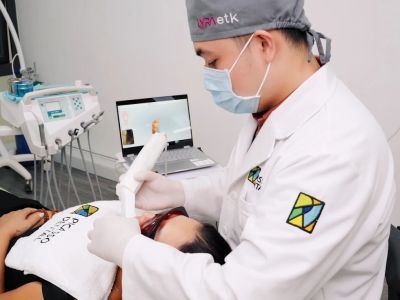
CAD/CAM stands for computer-aided design and computer-aided manufacturing. In dental applications, it means the clinic scans your prepared tooth digitally, designs the crown in software, and sends the design file directly to a milling unit in the building. The machine carves the crown from a zirconia blank in approximately 20-40 minutes. After sintering and staining, the crown is fitted the same day.

Without in-house milling, the clinic sends a physical or digital impression to an external lab. Most Vietnamese labs turn around zirconia crowns in 1-3 working days. This is fast by international standards (Australian lab turnarounds are typically 5-10 days), but it does mean the minimum trip length is usually 2 days to allow for lab time.

Select partner clinics in HCMC, Hanoi and Da Nang operate in-house milling units. This matters most if you are combining a crown with a short Vietnam trip, or if you need a replacement crown on an existing implant and have limited time in-country. When booking, confirm in advance whether in-house milling is available and whether same-day turnaround is feasible for your specific case, since some restoration types (such as multi-unit bridges) require lab work even with milling equipment on-site.

Material comparison

Zirconia vs PFM vs E.max

Three crown materials dominate modern dentistry. Here is a direct comparison to help clarify which is appropriate for your situation.

Property Zirconia PFM (porcelain-fused-to-metal) E.max (lithium disilicate)
Metal content None Metal alloy coping (cobalt-chrome or precious) None
Aesthetics Very good (monolithic); excellent (layered, Prettau) Good in front; dark gum line risk over time Excellent, most lifelike translucency
Strength Highest, ideal for all positions High metal strength; porcelain surface chips High, not recommended for back molars under heavy load
Price (Vietnam) US$245 – US$425/unit US$130 – US$200/unit US$300 – US$480/unit
Lifespan 15-20+ years 10-15 years (porcelain chipping common) 10-15 years
Best for All positions; implant crowns; bruxism patients Budget cases; older existing bridgework Upper front teeth where maximum aesthetics are the priority
Why zirconia

Why zirconia has replaced PFM in Vietnamese practices

PFM is declining at top-tier clinics

Porcelain-fused-to-metal (PFM) crowns were the dominant restorative material for decades. They are still available at most partner clinics and remain a budget option from US$180/unit. However, most top-tier Vietnamese clinics now default to monolithic zirconia for posterior teeth rather than PFM, because zirconia is stronger, does not show a metal margin at the gumline, and does not risk the porcelain-to-metal bond failure that causes porcelain chipping on PFM crowns over time.

E.max for front teeth: the aesthetic benchmark

For single anterior crowns requiring the highest level of natural translucency, E.max (lithium disilicate) remains the benchmark. It transmits light through the crown body in a way that very closely mimics natural enamel, producing results effectively indistinguishable from natural teeth at conversational distance. E.max costs US$320-425/unit in Vietnam versus US$245-280 for monolithic zirconia, but the aesthetic premium is worth it for high-visibility front tooth replacements.

When monolithic zirconia beats E.max

For premolars, molars, long-span bridges, implant-supported crowns, and patients with bruxism, monolithic zirconia beats E.max on every clinical measure: higher fracture resistance (1,000-1,200 MPa vs 350-400 MPa for E.max), no porcelain layer to chip, compatible with all cementation protocols, and no risk of catastrophic failure. The slight opacity trade-off is irrelevant for teeth not in the high-visibility smile zone.

The no-metal advantage for implant crowns

Implant-supported crowns have a screw channel or cement margin that makes metal visibility a particular concern. Monolithic zirconia implant crowns have no metal component, which eliminates the grey metal show-through that can occur at the gum margin with PFM implant crowns as gums recede naturally over years. For this reason, zirconia has become the standard implant crown material at top-tier Vietnamese partner clinics regardless of tooth position.

City selection

Which city for zirconia crowns?

Clinical outcomes are equivalent across all five SmileJet cities. In-house CAD/CAM milling, which enables same-day crowns, is most common in HCMC, Hanoi and Da Nang.

Ho Chi Minh City

Maximum clinic choice and the widest availability of in-house CAD/CAM milling. Year-round direct flights from AU, NZ and the UK. Best if you want same-day crowns or branded blanks such as Lava and Prettau.

Da Nang

Top-tier clinics stocking Lava and Prettau, with in-house milling at select practices. Beach-walk recovery near My Khe Beach. Good flight connections to Sydney, Melbourne and Singapore.

Hanoi

In-house milling available at select clinics. Cool dry weather October to April, Old Quarter cafes and walking culture. Direct flights from Australia via Singapore.

Hoi An

Unhurried recovery pace in the UNESCO Ancient Town. Crowns are typically lab-milled (1-3 days). Fly into Da Nang (DAD) and transfer 30 minutes by car.

Phu Quoc

Visa-free for all passports flying direct, with resort beach recovery. Smaller clinic network, generally external-lab turnaround, but full SmileJet verified standards apply.

Patient FAQ

Common zirconia crown questions

How much do zirconia crowns cost in Vietnam?
Zirconia crowns in Vietnam range from US$245 to US$425 per unit depending on type and city. Monolithic zirconia starts at US$245/unit; high-translucency monolithic from US$265/unit; layered zirconia from US$280/unit. Prices in HCMC and Phu Quoc average US$280/unit, Da Nang and Hoi An US$270/unit, and Hanoi US$275/unit.
What is the difference between monolithic and layered zirconia?
Monolithic zirconia is milled from a single block of zirconium dioxide, making it stronger and less prone to chipping, but slightly more opaque. Layered zirconia has a zirconia coping with hand-applied porcelain on top for greater translucency; it matches natural teeth more closely but is marginally less strong. Molars and heavy chewers suit monolithic; front teeth typically suit layered or high-translucency monolithic.
Is same-day zirconia possible in Vietnam?
Yes. Select partner clinics in HCMC, Hanoi and Da Nang operate in-house CAD/CAM milling units. After a digital scan of your prepared tooth, the crown is milled on-site in 1-2 hours and fitted the same day. Most clinics without in-house milling turn around crowns in 1-3 days via an external lab.
Are Lava and Prettau zirconia brands available in Vietnam?
Yes. Lava (3M) and Prettau (Zirkonzahn) are both stocked at top-tier partner clinics in HCMC and Da Nang. These branded zirconia blanks are imported and command a small premium over generic-grade Vietnamese or Chinese-sourced zirconia. When requesting a branded material, confirm the product documentation with the clinic before treatment.
How long do zirconia crowns last?
Zirconia crowns last 15-20+ years with proper care. Monolithic zirconia has the strongest track record for longevity in high-stress positions. Layered zirconia can occasionally experience porcelain chipping at the surface, though the underlying coping remains intact. Good oral hygiene and avoiding grinding are the main longevity factors.
How many trips are needed for zirconia crowns in Vietnam?
Most patients complete the full zirconia crown process in one trip of 1-5 days. Day 1 covers consultation, shade matching and tooth preparation; the crown is delivered on day 2-3 from an external lab, or same-day if the clinic has in-house milling. Clinics with in-house CAD/CAM can sometimes complete everything in a single day, making zirconia crowns viable even on a short stopover.
Take the next step

Get your free, personalised zirconia crown quote

Tell us your case, choose your city, and we will match you with a verified Vietnamese clinic within 24 hours. Free. No obligation. No fees added to clinic pricing.

Browse Vietnam clinics
4.8 ★ average clinic rating Free · No obligation Reply within 24 hours