Dental Tourism
CBCT Imaging and Digital Dentistry in Hanoi: The Technology Behind Modern Implants (2026)
Why imaging and digital workflow matter for dental tourists: CBCT 3D scanning, intraoral scanners, CAD/CAM crowns, and guided surgery are now the difference between a 30-year implant and a short-lived case, here is exact...
CBCT Imaging and Digital Dentistry in Hanoi: The Technology Behind Modern Implants (2026)
The gap between a 30-year implant and a 3-year failure is rarely the surgeon's hands, it's the technology stack behind the scan. Here is exactly what CBCT, intraoral scanning, CAD/CAM, and guided surgery look like in the top Hanoi clinics, what to ask for, and what each piece actually costs.
Quick Summary
In 2026, Hanoi's top-tier dental clinics operate a digital workflow that rivals (and in many cases exceeds) average suburban practices in Australia, the UK, or the USA. A complete modern implant case uses: CBCT for 3D bone and nerve imaging, an intraoral scanner (iTero / 3Shape TRIOS / Medit) instead of gagging impressions, digital smile design software to preview the result, a 3D-printed surgical guide for sub-millimetre implant placement, and CAD/CAM milled zirconia crowns. This guide breaks down the specific hardware (Vatech Green, Planmeca ProMax, Sirona Orthophos, Carestream), the software (coDiagnostiX, NobelClinician, Exocad, Blue Sky Plan), the costs, and which 7 listed Hanoi clinics run the full stack. If your quoted clinic is still doing 2D X-rays and alginate impressions in 2026, walk away.
On this page
- Why dental technology matters for international patients
- What is CBCT and how is it different from a panoramic X-ray?
- The CBCT machines used in Hanoi (Vatech, Sirona, Planmeca, Carestream)
- CBCT radiation dose and safety
- Intraoral scanners: goodbye to gagging impressions
- Digital smile design (DSD, Exocad): previewing your result
- CAD/CAM: same-day crowns, CEREC, and milled zirconia
- Guided surgery vs freehand: why the accuracy gap matters
- Digital treatment planning software (coDiagnostiX, NobelClinician)
- 7 Hanoi clinics with a full digital workflow
- Pricing: CBCT, digital scans, guided surgery
- What to ask a Hanoi clinic about their tech stack
- Future tech: AI diagnostics, robot surgery, same-day placement
- FAQs
Why dental technology matters for international patients
When you fly to Hanoi for implants, All-on-4, or a full-mouth restoration, you compress a treatment timeline that would take 6 to 9 months at home into 7 to 14 days of travel. That compression is only safe if the clinic has eliminated guesswork from the process, and guesswork is eliminated by replacing analogue steps with digital ones. A modern Hanoi implant case is a chain of digital artefacts: a CBCT DICOM file, an STL intraoral scan, a CAD-designed crown, a 3D-printed surgical guide, a milled final prosthesis. Each artefact is checkable, copyable, and second-opinion-able.
The same tech stack also protects your case after you go home. Your Hanoi clinic can send the DICOM and STL files to a dentist in Sydney or London for remote review. A traditional alginate impression cannot be shipped, reviewed, or re-milled six months later. A digital scan can. This is why the depth of a clinic's tech stack is now the single best proxy for international-patient readiness, more reliable than a 4.9-star Google rating or a photogenic website.
For a broader view of how Hanoi compares as a destination, start with the Hanoi dental tourism destination page, or the Dental Implants Hanoi Complete Guide 2026.
What is CBCT and how is it different from a panoramic X-ray?
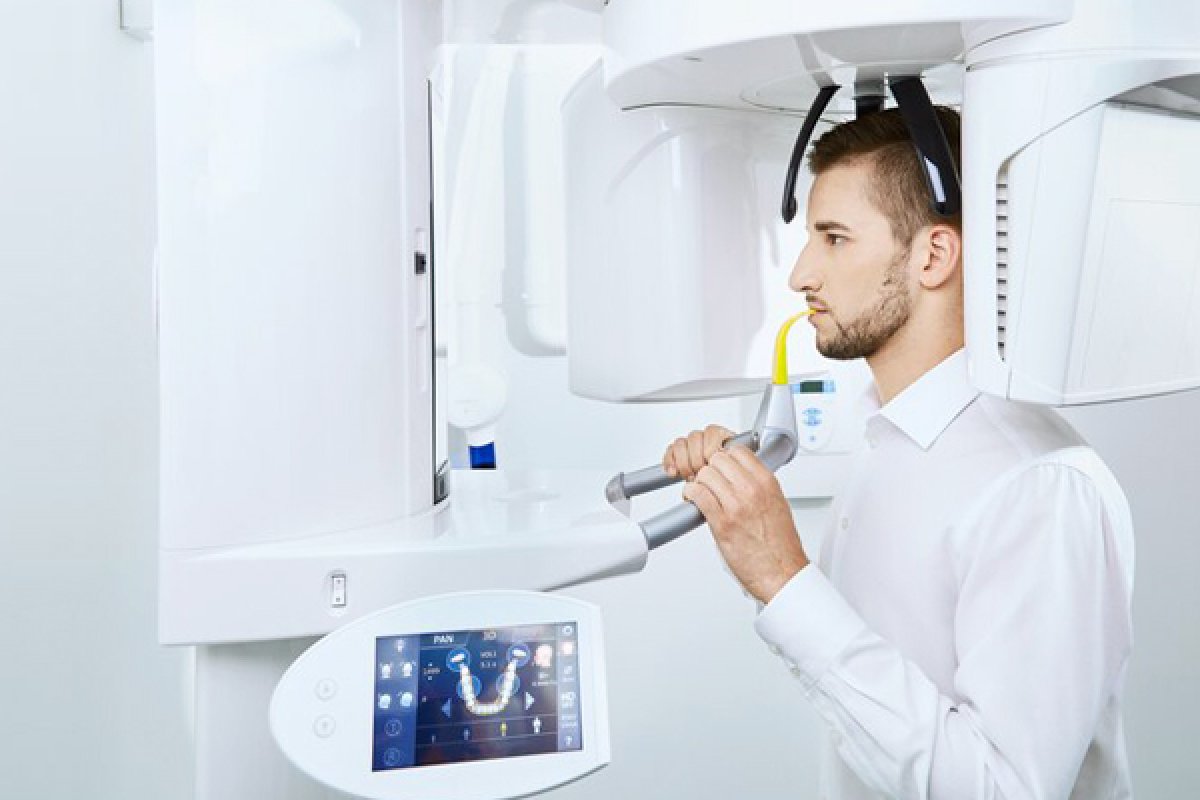
CBCT stands for Cone Beam Computed Tomography. Unlike a traditional 2D panoramic X-ray (which captures a flattened curved image of the jaws in about 14 seconds), CBCT rotates an X-ray source and flat-panel detector 180 to 360 degrees around your head in a single pass of 15 to 30 seconds, producing a volumetric 3D dataset of approximately 300 to 600 cross-sectional slices.
What that means clinically:
- Bone volume and density, your implantologist can measure the height and width of bone at every potential implant site in three dimensions, and assess the Hounsfield unit density to predict primary stability.
- Inferior alveolar nerve position, the mandibular canal is mapped in 3D. Damaging this nerve causes permanent lower-lip numbness. A 2D pan cannot show its depth relative to a planned implant.
- Maxillary sinus floor, upper posterior implants live beneath the sinus cavity. CBCT shows the exact sinus floor height and any mucosal thickening that would complicate a sinus lift. See our full sinus lift in Hanoi guide.
- Pathology, cysts, impacted teeth, residual roots, and bone defects become visible that would be entirely missed on a 2D film.
- Surgical guide fabrication, the CBCT DICOM file is the raw material from which your 3D-printed surgical guide is designed. No CBCT means no guide, which means freehand placement.
Panoramic X-ray vs CBCT vs medical CT at a glance
| Imaging | Dimensions | Typical dose | Use |
|---|---|---|---|
| Intraoral periapical X-ray | 2D | 0.005 mSv | Single-tooth caries, root canal |
| Panoramic (OPG) X-ray | 2D (curved) | 0.01–0.03 mSv | General overview, wisdom teeth screening |
| Dental CBCT (focused FOV) | 3D volumetric | 0.05–0.10 mSv | Implant planning, endodontics, pathology, orthodontics |
| Medical CT (head) | 3D volumetric | 2.0 mSv | Hospital neurological / maxillofacial |
| Average annual background | , | 2.4 mSv | Natural exposure, sea level |
The CBCT machines used in Hanoi (Vatech, Sirona, Planmeca, Carestream)
There are roughly a dozen CBCT manufacturers globally; four brands dominate the Hanoi market. The specific model a clinic runs is a strong signal of their overall equipment budget, patient throughput, and imaging quality. A clinic running a Vatech Green 16 or Planmeca ProMax 3D Mid has spent US$80,000 to US$160,000 on that single piece of kit.
Vatech Green series (Korea)
Vatech is South Korea's dental imaging champion and the single most common CBCT brand in top-tier Hanoi clinics. The Green 16, Green X, and Smart Plus models offer selectable field-of-view from 5x5 cm (single-tooth endo) to 16x9 cm (full-arch, TMJ), low-dose protocols, and DICOM export. Patient throughput is fast (scans complete in under 20 seconds), which is why high-volume clinics like Picasso favour them. Signal: a clinic running a current-generation Vatech has invested in mainstream international-standard imaging.
Dentsply Sirona Orthophos (Germany / USA)
Sirona's Orthophos SL 3D and Orthophos E units are the German-standard CBCT platform, common in European specialist clinics and premium Hanoi clinics with Western-trained principals. Fully integrated with Sirona's CEREC CAD/CAM ecosystem, which means if a clinic runs both, they can pull CBCT + intraoral scan + crown design into one workflow. Signal: deep European-standard integration, higher price ceiling.
Planmeca ProMax 3D (Finland)
Planmeca's ProMax 3D family offers some of the lowest-dose protocols in the industry (ULD, Ultra Low Dose, can deliver a full implant planning CBCT at roughly 0.02 to 0.04 mSv, on par with a single OPG). Popular with clinics that treat significant paediatric or orthodontic caseload, and a strong signal of radiation-safety-conscious practice. Integrates with Planmeca's Romexis software for treatment planning.
Carestream CS 8100 and CS 9600 (USA)
Carestream's CS 8100 3D is one of the most widely deployed CBCT platforms globally and a workhorse in mid-to-premium Hanoi clinics. Good image quality, reasonable dose, reliable DICOM export, and strong integration with third-party planning tools like coDiagnostiX and Blue Sky Plan. Signal: a mainstream, internationally-compatible imaging platform.
Brands to raise an eyebrow at include unbranded Chinese CBCT platforms sold at US$35,000 to US$55,000. These do exist in Hanoi's budget-tier clinics. They can produce acceptable images in favourable cases but often have poorer dose efficiency, inconsistent DICOM output, and limited integration with international planning software. If a clinic will not name their CBCT brand and model in writing, treat it as a red flag, and cross-reference with our 10 questions to ask before booking a Hanoi clinic (question 3 covers CBCT in depth).
CBCT radiation dose and safety (ALARA in practice)
Radiation is the single most common question from international patients considering CBCT. The answer is that modern dental CBCT is one of the lowest-dose 3D imaging modalities available, a typical focused-FOV implant CBCT delivers 0.05 to 0.10 mSv, which is roughly equivalent to 2 to 4 weeks of natural background radiation or a single long-haul international flight at altitude.
Compare that to:
- A single panoramic X-ray: 0.01 to 0.03 mSv
- A medical chest X-ray: 0.10 mSv
- A medical CT of the head: 2.0 mSv (20 to 40 times more than a dental CBCT)
- An abdominal CT: 10 mSv
The international radiological principle governing all dental imaging is ALARA, As Low As Reasonably Achievable. In practice, a responsible Hanoi implant clinic will:
- Use the smallest field of view (FOV) that covers the clinical area of interest (5x5 cm for single-tooth, 8x8 cm for quadrant, 10x10 cm for full-arch planning).
- Apply low-dose or ultra-low-dose scan protocols where image quality permits.
- Apply lead apron and thyroid collar where applicable.
- Defer CBCT in pregnancy unless clinically essential; if essential, shield and document.
- Apply lower-dose paediatric protocols for under-18 patients.
- Justify and document the clinical need for the scan, CBCT is not a screening tool.
Intraoral scanners: goodbye to gagging impressions
If you have ever had a crown, bridge, or denture made the traditional way, you know the feeling, and it's one of the first things patients ask about when planning crowns or veneers in Hanoi. Our veneers vs crowns in Hanoi guide covers exactly how digital impressions have transformed both procedures. of a full tray of alginate or polyvinyl siloxane impression material jammed against your back palate for 90 to 120 seconds while your gag reflex tries to eject it. That experience is now entirely avoidable.
A modern intraoral scanner is a hand-held digital wand that captures your teeth and soft tissues as a real-time 3D mesh (STL file), typically in 3 to 6 minutes. The three dominant platforms in Hanoi are:
iTero Element 5D (Align Technology)
iTero is the scanner of choice for Invisalign workflows and is widely used in Hanoi's top orthodontic and prosthodontic practices. The Element 5D adds near-infrared imaging for interproximal caries detection. Colour scans, fast capture, excellent soft-tissue rendering. Used at Picasso Dental and a handful of premium Hanoi orthodontic practices.
3Shape TRIOS 5 (Denmark)
3Shape's TRIOS 5 is the Formula 1 of intraoral scanners, wireless, fast, excellent colour, and the broadest ecosystem of exportable file formats. Dominant in European and Australian clinics, found in Hanoi's premium practices that trained in Europe. Strong integration with Exocad, 3Shape Dental System, and third-party milling.
Medit i500 and i700 (Korea)
Medit has become the value champion, excellent scan quality at a significantly lower price point than iTero or TRIOS, and it has opened up intraoral scanning to mid-tier Hanoi clinics that couldn't justify a US$40,000 3Shape spend. Medit i500 is now the most common digital impression tool in mid-market Hanoi implant practices.
The clinical benefit is not just comfort: digital scans eliminate distortion from impression material tear, operator technique variability, and shipment damage. The STL file is transmitted to the lab or CAD/CAM mill in seconds. Re-makes, if ever needed, can be done from the same file without recalling the patient.
Digital smile design: previewing your result before treatment
Digital Smile Design (DSD) and Exocad's Smile Creator are software workflows that combine your intraoral scan, CBCT, clinical photography, and (in some workflows) video of your smile and speech into a digital mockup of the final restoration. Your dentist can show you, before any irreversible treatment, what your teeth will look like after veneers, crowns, or a full-arch rehabilitation.
The process typically runs:
- A series of standardised clinical photos (full face, retracted smile, profile, occlusal).
- An intraoral scan (STL) and CBCT (DICOM) are overlaid.
- The dentist designs a proposed smile in 3D, tooth proportions, midline, incisal edge position, gingival zenith, papilla height.
- The digital design is exported and either printed as a 3D mockup tried in your mouth, or rendered as a photo showing your face with the new smile.
- You approve the design before any tooth is prepared. Changes are digital, not physical.
For cosmetic cases, veneer cases, crown-and-bridge, All-on-4 full-arch, DSD turns the treatment from "trust me, it'll look great" into a contractual visual agreement. It's one of the most-requested digital capabilities from international patients arriving in Hanoi.
CAD/CAM: same-day crowns, CEREC, and milled zirconia
CAD/CAM stands for Computer-Aided Design / Computer-Aided Manufacturing. In dentistry, the workflow is:
- Intraoral scan → STL file.
- CAD software (CEREC SW, Exocad, 3Shape Dental System) designs the crown, bridge, or full-arch prosthesis.
- A 5-axis milling machine (e.g. Sirona MC XL, Ivoclar PrograMill PM7, Roland DWX) carves the restoration from a solid block of zirconia, lithium disilicate, or temporary PMMA.
- The milled restoration is sintered (for zirconia), glazed, and characterised.
The clinical implications for dental tourists are substantial:
- Same-day crown possibility, for single crowns, a clinic with in-house CEREC or Ivoclar PrograMill can scan, design, mill, and cement in 2 to 3 hours. No temporary crown, no second appointment, no return flight for the seating visit.
- Faster full-arch timelines, for All-on-4 and full-mouth rehab, the zirconia prosthesis can be milled locally instead of shipped to Korea or Germany, compressing the 14-day treatment window that is the critical path for most international patients.
- Consistent quality, a 5-axis mill does not have bad-hand days. Every crown hits the designed occlusion within a few dozen microns.
- Digital traceability, the CAD file is archived. If the crown chips in year 3, your clinic can re-mill an identical replacement from the same STL.
The top-tier Hanoi clinics that operate an in-house CAD/CAM mill include Picasso Dental, Westcoast International, and Home Dental. Others outsource milling to a dedicated dental lab in Hanoi or Seoul, which adds 3 to 5 days to the turnaround but can mean cheaper pricing per unit.
Guided surgery vs freehand: why the accuracy gap matters
Guided implant surgery is the clinical application of the entire digital stack. The process:
- CBCT DICOM file.
- Intraoral STL scan merged with the DICOM in planning software.
- Virtual implant placement, the surgeon positions each implant in software, checking angulation, depth, and proximity to nerve and sinus.
- Surgical guide designed based on the virtual plan.
- Guide 3D-printed (typically SLA resin, e.g. Formlabs Form 3B+, Asiga Max, SprintRay Pro) or milled.
- The guide seats over the teeth or bone and includes precision-fitted metal sleeves that force the drill into the exact planned trajectory.
Published academic data on accuracy:
- Freehand implant placement: average 3D deviation at the apex of 2.0 to 3.5 mm; angular deviation of 5 to 9 degrees.
- Partially guided (pilot drill guide only): apex deviation 1.5 to 2.5 mm; angular 3 to 5 degrees.
- Fully guided (all drills through the guide + guided implant seating): apex deviation 0.8 to 1.5 mm; angular 1 to 3 degrees.
For single implants in ample bone, the difference is often clinically negligible. For implants within 2 mm of the inferior alveolar nerve, within 3 mm of the sinus floor, immediate same-day implant placement, All-on-4 with strategic angulation, or full-mouth restoration where screw access must emerge through the final prosthesis cingulum, the difference is the case.
Digital treatment planning software in Hanoi clinics
The planning software is where the digital case actually comes together. Your surgeon sits at a workstation, opens the merged CBCT + STL dataset, and spends 30 to 90 minutes placing virtual implants, checking bone volume, simulating bone grafting, and designing the surgical guide. The dominant platforms in Hanoi:
- coDiagnostiX (Dental Wings / Straumann Group), the standard planning suite for Straumann implant cases. Used extensively at Picasso Dental and Australian Dental for Straumann implant planning.
- NobelClinician / DTX Studio Implant (Nobel Biocare / Envista), the native planning software for Nobel Biocare implants, with fully integrated guide manufacturing service through NobelGuide.
- Blue Sky Plan (free / commercial), open-format planning software widely used in mid-market clinics, compatible with most implant systems and third-party surgical guide manufacturers.
- 3Shape Implant Studio, fully integrated with the 3Shape TRIOS scanner workflow, popular in clinics using 3Shape end-to-end.
- Exocad DentalCAD + PartialCAD, more commonly used for prosthetic design than surgical planning, but covers the full CAD workflow for crowns, bridges, and full-arch.
If you want to understand exactly which Straumann implant systems Hanoi clinics pair with coDiagnostiX planning, and how the BLX immediate-loading protocol integrates with guided surgery, see our guide to Straumann implants in Hanoi 2026, with pricing for Standard Plus through BLX and a clinic-by-clinic comparison.
The software brand matters less than whether the clinic actually uses it for every implant case. Ask to see a redacted screenshot of a past case plan, a clinic that runs digital planning routinely will send one without hesitation.
Want to see which Hanoi clinics run the full digital stack?
SmileJet pre-verifies every Hanoi clinic's equipment: CBCT brand, intraoral scanner, CAD/CAM mill, guided-surgery capability, and planning software. Browse by tech depth, not just price.
Explore listed Hanoi clinics7 Hanoi clinics with a full digital workflow (2026)
The following seven clinics operate a complete digital dentistry stack, CBCT, intraoral scanner, CAD/CAM milling, guided surgery, and digital treatment planning, as of SmileJet's 2026 equipment audit.
1. Picasso Dental Clinic, Old Quarter Branch
Runs a Vatech Green 16 CBCT, iTero Element 5D intraoral scanner, in-house 5-axis CAD/CAM mill, and coDiagnostiX + NobelClinician for treatment planning. Fully-guided surgery is standard for All-on-4 and full-mouth cases. Implant partnerships with Straumann, Nobel Biocare, and Dentium.
2. Picasso Dental Clinic, Westlake Square Branch
Same clinical tech stack as the Old Quarter branch, Vatech Green CBCT, iTero, in-house CAD/CAM, and guided surgery standard for complex cases, positioned specifically for expat and international arrivals with a dedicated international coordinator and English-first clinical team.
3. Westcoast International Dental Clinic, West Lake Hanoi
One of Hanoi's longest-running international clinics. Runs a Sirona Orthophos SL 3D CBCT integrated with a 3Shape TRIOS 5 scanner and Sirona CEREC CAD/CAM. Fully-guided surgery available on implants, using coDiagnostiX for Straumann cases and NobelClinician for Nobel Biocare.
4. Australian Dental Clinic Hanoi
Australian-standard protocols with a Planmeca ProMax 3D CBCT (notable for low-dose ULD protocols), 3Shape TRIOS scanner, and outsourced precision milling via a German-certified lab partner. Strong Straumann and zirconia focus.
5. Home Dental Clinic Hanoi
Operates a Carestream CS 8100 3D CBCT, Medit i500 intraoral scanners across branches, and in-house CAD/CAM milling for single-unit crowns. Implant options include Straumann, Osstem, and Dentium. Good digital workflow depth at mid-market pricing.
6. Global Dental Clinic Hanoi
Runs a Vatech Green X CBCT, 3Shape TRIOS scanner, and outsources milling to a premium Hanoi-based dental lab. Strong on All-on-4 cases with fully-guided surgery using coDiagnostiX.
7. Greenfield Dental Clinic Hanoi
Boutique clinic with a Vatech Smart Plus CBCT and Medit i500 intraoral scanner. Implant planning in Blue Sky Plan, with guided surgery on premium packages. Uses Straumann and Osstem implants.
Pricing: CBCT, digital scans, guided surgery in Hanoi vs abroad
Digital technology in Hanoi clinics costs the same to buy as anywhere else in the world, a Vatech Green 16 CBCT costs the same in Hanoi as in Sydney. What differs is the labour and overhead around it. Here is the 2026 price landscape.
| Service | Hanoi (listed clinics) | Australia | USA |
|---|---|---|---|
| CBCT scan (standalone) | Free–US$80 | AUD$250–$450 (~US$170–$310) | US$300–$600 |
| CBCT included with implant consult | Free (standard) | Bundled at premium clinics | Rarely bundled |
| Intraoral digital scan (STL) | Free–US$40 | AUD$100–$200 | US$150–$350 |
| Digital smile design (full workflow) | US$60–$200 | AUD$500–$1,200 | US$400–$1,500 |
| 3D-printed surgical guide (per arch) | US$200–$600 | AUD$800–$1,800 | US$600–$2,000 |
| Same-day CAD/CAM zirconia crown | US$280–$480 | AUD$1,600–$2,400 | US$1,400–$2,800 |
| DICOM + STL file export | Free on request | Free–AUD$50 | Free–US$100 |
For full brand-specific pricing, see the Dental Implants Hanoi Complete Guide 2026, the Straumann in Hanoi guide, or the Osstem in Hanoi guide.
What to ask a Hanoi clinic about their tech stack
These are the questions we recommend sending to any shortlisted Hanoi clinic, specifically to probe the depth of their digital workflow. For the full 10-question framework covering clinicians, warranties, and after-care, see 10 Questions to Ask Before Booking a Hanoi Dental Clinic.
- Which brand and model CBCT do you operate? A good clinic names the specific model (e.g. "Vatech Green 16") without hesitation.
- Is the CBCT in-house or at a partner facility? In-house is strongly preferred for planning iteration.
- Will you provide the DICOM file on request? Yes is the only correct answer. This is your clinical data.
- What intraoral scanner do you use? Should name iTero, 3Shape TRIOS, or Medit.
- Which software do you use for implant planning? Should name coDiagnostiX, NobelClinician, Blue Sky Plan, or 3Shape Implant Studio.
- Is fully-guided surgery included in my implant quote? For full-arch and high-risk cases, should be yes.
- Where is the surgical guide manufactured? In-house 3D printing is fastest and reduces shipping risk.
- Where are crowns / prostheses milled? In-house CAD/CAM or named lab in Vietnam / Korea / Germany.
- Do you offer digital smile design before cosmetic work starts? Should be yes for veneers, full-arch, or any smile-zone case.
- Can I get a second-opinion review of my CBCT and treatment plan? A confident clinic welcomes this.
Future tech: AI diagnostics, robot-assisted surgery, same-day arches
The current state of digital dentistry in Hanoi is genuinely impressive, the next 24 to 36 months will push it further. What's coming:
AI-assisted diagnostics
Cloud-based AI services (Overjet, Pearl, Diagnocat, VideaHealth) are beginning to be integrated into Hanoi clinic workflows, with automated caries detection on bitewing X-rays, periodontal bone loss quantification on panoramic films, and automatic anatomical landmark identification on CBCT scans. This does not replace the dentist, but it does catch pathology a tired operator might miss and produces a reproducible audit trail.
Robot-assisted implant surgery (Yomi)
Neocis's Yomi is the first FDA-cleared robotic system for dental implant surgery. It uses haptic guidance, physically constraining the drill to the CBCT-planned trajectory, for accuracy better than any passive surgical guide. As of 2026 Yomi is deployed at fewer than 500 clinics globally, and is not yet in Hanoi, but the technology trajectory is clear: robot-assisted placement will appear at the top-tier Hanoi full-arch centres within 2 to 4 years.
On-arrival-to-insertion in 24 hours
The digital stack, CBCT on arrival morning, merged with pre-sent intraoral scan, guide 3D-printed the same afternoon, implants placed the next morning, is compressing the treatment window for international patients. A small number of Hanoi clinics can now deliver single implants, and in select cases full-arch immediate-load cases, within a 24-to-48 hour window from arrival, provided pre-travel planning is complete. See our same-day dental implants in Hanoi guide for the full protocol and which clinics offer it.
Intraoral 3D printing and chairside full-arch fabrication
Chairside 3D printers (SprintRay Pro95 S, Asiga Max UV, Formlabs Form 3B+) are moving from prototype lab work into clinical same-day denture, surgical guide, and night-guard production. For international patients, this means that fewer components need shipping to a central lab, compressing the 14-day travel window to 10 days or less.
Pick the clinic with the right tech, not just the lowest price
A US$900 Straumann implant placed freehand with a 2D X-ray is not the same product as a US$1,200 Straumann implant placed with CBCT-planned, fully-guided surgery. SmileJet surfaces the equipment stack behind every Hanoi clinic so you can compare like-for-like.
See all listed Hanoi clinicsFAQs
What is a CBCT scan and why is it essential for dental implants in Hanoi?
CBCT (Cone Beam Computed Tomography) is a 3D X-ray that captures your jawbone, sinuses, and nerve canals in a single 15-to-30-second scan. It is essential for implant planning because a 2D panoramic X-ray cannot show bone width, nerve proximity, or sinus floor position accurately. In Hanoi 2026, top clinics like Picasso Dental, Westcoast International, and Australian Dental all operate in-house CBCT units (typically Vatech Green, Carestream CS 8100, or Planmeca ProMax) and include the scan free or at US$30 to US$50 with implant consultation.
How much does a CBCT scan cost in Hanoi compared to Australia or the USA?
A standalone CBCT scan in Hanoi costs between free and US$80 at top implant clinics in 2026, and is often bundled free with an implant consultation. The same scan in Australia typically costs AUD$250 to AUD$450 (roughly US$170 to US$310), and in the USA costs US$300 to US$600. Vietnamese clinics pass the lower equipment leasing, labour, and radiographer costs directly to the patient, which is one of the main reasons Hanoi is 70 to 80 percent cheaper than the West on total implant cost.
Is CBCT radiation safe? How does the dose compare to medical CT?
Yes, CBCT is significantly safer than a medical CT scan. A typical dental CBCT delivers 0.05 to 0.1 millisieverts of radiation, roughly equivalent to 2 to 4 weeks of natural background radiation, or a single transatlantic flight. A medical head CT delivers 2 millisieverts (20 to 40 times more). The ALARA principle (As Low As Reasonably Achievable) is standard in modern Hanoi clinics using Vatech Green 16 or Planmeca ProMax 3D machines, which use low-dose protocols and collimation to limit exposure. CBCT is not recommended in pregnancy unless clinically critical, and paediatric imaging requires lower-dose field-of-view settings.
What is guided implant surgery and why is it more accurate?
Guided implant surgery uses a 3D-printed or milled surgical guide, designed on your CBCT data using software like coDiagnostiX, NobelClinician, or Blue Sky Plan, to position the implant with sub-millimetre accuracy. Freehand placement has an average angular deviation of 5 to 9 degrees; fully-guided placement narrows this to under 2 degrees. For All-on-4, full-mouth restoration, or implants near the inferior alveolar nerve or maxillary sinus, this accuracy gap is the difference between a 30-year implant and a compromised case. Picasso Dental, Westcoast International, and Home Dental all offer guided surgery on their premium implant packages.
Which Hanoi clinics have the most advanced digital dentistry tech stack?
In SmileJet's 2026 technology audit, the top-ranked Hanoi clinics for digital workflow depth are Picasso Dental (both branches) with iTero scanners, in-house CBCT, CAD/CAM milling and guided surgery; Westcoast International with full 3Shape TRIOS + Exocad + in-house CEREC workflow; Home Dental with Medit i500 scanners and same-day zirconia crowns; Australian Dental with Planmeca CBCT and NobelClinician planning; and Global Dental with Vatech Green plus 3Shape TRIOS. All five run a fully digital impression-to-milling chain for standard prosthetic cases.
Ready to pick the right Hanoi clinic for your case?
Use SmileJet to filter Hanoi clinics by the tech stack they actually run, CBCT brand, scanner, CAD/CAM mill, guided surgery, and send your pre-arrival enquiry to the top 3.
Start your Hanoi shortlistPrices are indicative; only a clinic's written quote applies to you. See how we source prices. SmileJet is an information service, not a healthcare provider, and nothing here is medical advice.
Want this priced for your own mouth? Send a photo and we will come back with written quotes from clinics that fit.
Get my quoteIf you are also looking at treatment
What it costs, and who does it.
Published clinic fees, not estimates. Indicative until a clinic puts a quote in writing.
Dental care in Hanoi
Prices, clinics and how a treatment trip there actually works.
Dental implants in Hanoi
What a single implant costs there, and which systems the clinics use.
Veneers in Hanoi
Composite, E.max and zirconia, with the price each clinic publishes.
All-on-4 in Hanoi
Full-arch pricing, how many trips it takes, and who handles the complex cases.
Keep reading
Related guides.
Questions to ask a Cuenca dentist before you book
Twelve questions that separate a quote you can rely on from one you cannot. Ask them before you book flights.
Why Ecuador quotes dental work in US dollars
Ecuador is the rare dental destination where the quoted number and the paid number are the same.
Ecuador, Costa Rica or Mexico for dental work
An honest comparison, including the ways Ecuador loses. We list one clinic there, and that is a real limitation.
Send a photo. Get three quotes.
It costs nothing and it does not commit you to anything. Most people hear back the same day.