Dental Tourism
Bogota vs Costa Rica for Dental Tourism: Which Is Better for US Patients? (2026)
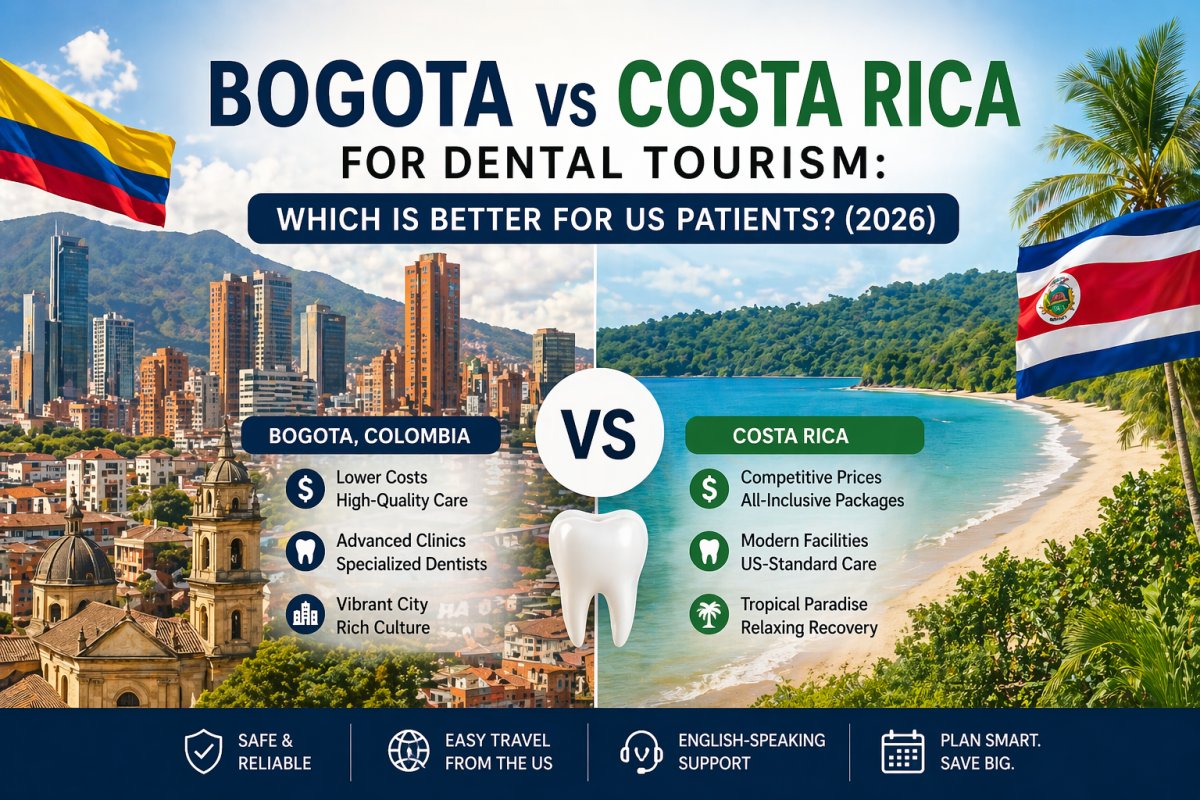
Costa Rica is one of the longest-established dental tourism destinations in the Americas. San José has hosted US dental patients since the 1990s, and clinics clustered around the western suburbs of Escazú and Santa Ana are deeply accustomed to English-speaking international patients. Over three decades of formalised medical tourism have produced a mature ecosystem of clinics, recovery accommodation, English-speaking support staff, and experienced patient coordinators.
Bogota is a newer but rapidly growing competitor. Colombia's capital offers equivalent clinical standards, consistently lower prices (particularly on complex cases), shorter flights from the US East Coast, and deeper surgical specialty expertise for large implant and full-mouth cases. For US patients deciding between the two destinations in 2026, the honest answer depends on case type, your home airport, and whether your priority is vacation experience or clinical depth and value.
This guide compares Bogota and Costa Rica fairly across costs, flight access, clinical quality, vacation value, safety, and language. Costa Rica wins some categories outright. Bogota wins others. We will name each winner clearly so you can match the destination to your actual needs.
Costa Rica Dental Tourism Overview
Costa Rica's dental tourism sector is concentrated in the San José metropolitan area, particularly the western suburbs of Escazú and Santa Ana. These neighbourhoods sit roughly 20 to 30 minutes from Juan Santamaría International Airport (SJO) and contain the majority of clinics that cater to international patients. The sector has been formalised since the mid-1990s, giving Costa Rica a multi-decade head start on most Latin American competitors.
Key strengths of Costa Rica as a dental destination include:
- Established English-speaking clinics. Three decades of US patient volume means front desk staff, patient coordinators, and dentists all operate comfortably in English.
- ADA-trained dentists. A meaningful share of Costa Rican dentists complete postgraduate training or continuing education through American Dental Association-recognised programmes in the United States.
- Strong medical tourism reputation. Costa Rica is internationally known for broader medical tourism beyond dental -- orthopaedic surgery, cosmetic surgery, and bariatric work -- which supports a mature ecosystem of recovery hotels and patient coordinators.
- Proximity to beach and nature destinations. Guanacaste, Manuel Antonio, Monteverde, and Arenal are all reachable for post-treatment recovery travel.
The typical Costa Rica dental patient comes from the US West Coast, Texas, Florida, or other southern states with direct flight access. Canadian patients are less common because of weaker direct flight options compared to Mexico.
Cost Comparison: Bogota vs Costa Rica (2026)
Pricing is the clearest point of difference. Costa Rica's prices have risen meaningfully since 2020, narrowing the gap with US prices, while Bogota's Colombian peso costs have stayed competitive despite inflation. All figures below are in US dollars for 2026 based on multiple listed clinic quotes in both cities.
| Treatment | Costa Rica (San José) | Bogota | Winner |
|---|---|---|---|
| Single implant + crown | USD 1,100-1,500 | USD 850-1,200 | Bogota ~20% cheaper |
| 10 e.max veneers | USD 5,500-7,000 | USD 4,500-5,500 | Bogota ~20% cheaper |
| All-on-4 per arch | USD 9,000-13,000 | USD 6,500-8,500 | Bogota ~30% cheaper |
| Full-mouth restoration | USD 18,000-24,000 | USD 14,000-20,000 | Bogota ~15-20% cheaper |
| Zoom whitening | USD 250-350 | USD 150-200 | Bogota |
Summary: Bogota is consistently cheaper across all categories. Costa Rica's prices have risen significantly since 2020, and the savings gap versus the United States is narrower than it was a decade ago. For complex surgical cases, Bogota's advantage is largest -- a patient needing All-on-4 in both arches saves roughly USD 5,000 to 9,000 by choosing Bogota over San José.
For a full breakdown of Bogota prices by treatment, see our Bogota dental implant pricing guide for 2026.
Flight Access Comparison
Flight access is where Costa Rica has a structural advantage for much of the United States. San José (SJO) has direct routes from more US cities than Bogota (BOG), particularly for West Coast and Central US travellers. Bogota is strongest from Miami and the East Coast.
| US City | To San José (SJO) | To Bogota (BOG) | Notes |
|---|---|---|---|
| Miami | 3h direct | 3.5h direct | Both on multiple airlines; similar fares |
| Houston | 3.5h direct | 4.5h direct | Costa Rica slightly faster from TX |
| Los Angeles | 6h direct | 8h (1 stop) | Costa Rica wins from West Coast |
| New York | 5h direct | 5.5h (1 stop) | Costa Rica direct; Bogota usually via MIA |
| Dallas | 4h direct | 5h (1 stop) | Costa Rica wins |
| Seattle | 8h (1 stop) | 9h (1 stop) | Roughly equal |
Verdict: Costa Rica wins flight access for West Coast and Central US patients -- more direct routes, shorter total travel time. East Coast patients are roughly equal. The one real exception is Miami, where Bogota's Avianca frequency is excellent and travel time is almost identical. For more on Bogota's US flight network, see our Bogota dental tourism guide for US patients.
Clinical Quality Comparison
Both destinations use the same major implant brands (Nobel Biocare, Straumann, Osstem) and the same digital workflows -- CBCT imaging, intraoral scanners, guided surgery, and digital smile design. The gap in raw equipment and materials is essentially zero. The real differences are in training backgrounds, clinic structure, and specialty depth.
Costa Rica
Many Costa Rican dentists complete postgraduate training in the United States or maintain continuing education through American Dental Association-recognised programmes. English fluency is very high at every level of the clinic. Costa Rican clinics tend to be smaller (2 to 4 chair boutique practices) with a tighter personal feel. For straightforward restorative and cosmetic cases, this structure is often more comfortable for nervous international patients.
Bogota
Colombian dental schools -- particularly at Universidad Nacional, Universidad de Antioquia, and Pontificia Universidad Javeriana -- are considered among Latin America's most academically rigorous. Oral and maxillofacial surgeons frequently lead the top clinics, which gives Bogota a structural advantage for complex full-mouth and implant surgery cases. English is reliable at clinic level in Bogota's northern districts but less common outside the clinic environment. Clinics tend to be larger multi-specialist practices with 5 to 15 chairs and multiple specialists on staff.
Verdict: For straightforward implant and cosmetic cases, clinical quality is effectively equivalent. For complex full-mouth rehabilitation, All-on-4 in both arches, or cases requiring surgical specialty involvement, Bogota's density of oral and maxillofacial surgeons gives it a slight edge.
Vacation Value Comparison
This is the category where Costa Rica's reputation genuinely earns its position. Costa Rica is internationally famous for ecotourism and has some of Latin America's most accessible natural attractions. Bogota is a high-altitude urban capital with cultural depth rather than a beach destination.
Costa Rica
San José is less a tourism destination and more a staging point. Patients typically complete their dental work in the capital and then travel to:
- Guanacaste -- Pacific coast beaches, resort towns like Tamarindo and Playa Conchal, and the Papagayo peninsula.
- Manuel Antonio -- Pacific coast national park famous for wildlife, beaches, and rainforest combined.
- Monteverde -- Cloud forest reserves with canopy walks, hanging bridges, and zipline tours.
- Arenal -- Volcano region with hot springs and adventure tourism.
- Corcovado -- One of the most biodiverse rainforests on the planet, on the Osa Peninsula.
The country's "pura vida" lifestyle and three decades of North American tourism mean every major attraction is easy to book, easy to navigate in English, and well-connected to San José.
Bogota
Bogota is a cultural and culinary destination rather than a beach destination. At 2,640 metres altitude in the Andes, it is cool year-round and decidedly urban. Highlights:
- Museo del Oro (Gold Museum) -- The world's best pre-Colombian goldwork collection, with over 34,000 pieces.
- La Candelaria -- Colonial quarter with cobbled streets, colourful buildings, and the Plaza Bolívar.
- Monserrate -- 3,152-metre peak overlooking the city, reached by funicular or cable car.
- Usaquén Sunday market -- Colonial village atmosphere in the upscale north.
- Food scene -- Bogota has emerged as one of Latin America's strongest fine-dining cities.
Bogota is not a beach-adjacent destination, but Cartagena -- Colombia's Caribbean colonial jewel -- is a 1-hour flight away for patients who want to combine urban culture with coast.
Verdict: Costa Rica wins for relaxation, nature, and beach vacation. Bogota wins for culture, museums, urban food, and city experience. These are genuinely different vacation types -- pick the one that matches how you actually want to recover.
Safety Comparison
Both countries carry the same US State Department travel advisory level in 2026, and the honest assessment is that the practical safety experience for dental tourists is similar -- provided you stay in the designated clinic districts of each city.
Costa Rica
Level 2 (Exercise Increased Caution) overall. Costa Rica has one of the lowest violent crime rates in Central America and is widely considered one of the safest countries in Latin America. San José's western suburbs of Escazú and Santa Ana, where most international dental clinics are located, are considered comfortably safe for tourists day and night. Standard urban precautions apply in central San José.
Colombia
Level 2 (Exercise Increased Caution). Bogota's northern districts -- Chapinero, Usaquén, Chicó Norte, and Country -- have safety profiles comparable to Costa Rica's upscale San José suburbs. These are affluent business districts patrolled by private security and are routinely used by international business travellers and diplomatic staff. Rural travel in flagged regions should be avoided.
Verdict: Effectively equal for dental tourists staying within the designated clinic districts of each city. Costa Rica has a lower aggregate violent crime rate, but the practical day-to-day experience in Escazú versus Chicó Norte is similar. See our full Bogota dental tourism guide for 2026 for more on neighbourhood choice.
Language and Cultural Access
Costa Rica
Very high English proficiency throughout San José's medical tourism zones. Three decades of catering to North American patients means restaurant staff, Uber drivers, tour operators, and hotel staff all operate comfortably in English. Costa Rican culture is informal, friendly, and familiar to US visitors. You can complete an entire two-week dental visit without learning a single Spanish word beyond "gracias".
Bogota
English is reliable at dental clinics and major international hotels, but fluency outside the clinic is more limited than in Costa Rica. Spanish is dominant. Basic phrases, a translation app, or the English-interface versions of Uber and Rappi (Colombia's dominant food delivery and services app) bridge most of the gap. Many patients find the cultural experience richer precisely because it requires slightly more effort.
Verdict: Costa Rica wins for smoother day-to-day English access across your entire trip. If easy English outside the clinic is important to you, this is a real Costa Rica advantage.
Recommended Bogota Clinics
If your comparison tilts toward Bogota, these are two listed SmileJet partner clinics chosen for different case profiles.
Treatment Complexity Recommendation
The honest answer depends on case type. Here is how we would recommend between the two destinations by clinical complexity.
Simple cases
1 to 3 implants, whitening, single crowns, or 4 to 6 veneers: both destinations work equally well. Clinical quality is equivalent, prices are within 20% of each other, and the savings difference on a USD 3,000 case is modest. Choose based on flight access and vacation preference rather than clinical depth.
Medium cases
8 to 10 veneers, 4 implants in one arch, or moderate bridgework: Bogota is approximately 20% cheaper, which represents USD 1,000 to 2,000 savings on a full cosmetic case. Costa Rica has slightly better English access throughout your recovery. If price matters more than broader English convenience, pick Bogota.
Complex cases
All-on-4 in both arches, full-mouth rehabilitation, or cases requiring oral surgery, sinus lift, or bone grafting: Bogota has deeper surgical expertise through its density of oral and maxillofacial surgeons, and prices are typically 25 to 35% lower than Costa Rica for these cases. Costa Rica handles complex cases well, but the cost-to-quality ratio favours Bogota meaningfully for procedures above USD 10,000. See our Bogota implants guide for a full breakdown.
Honest Verdict by Patient Profile
Choose Costa Rica if...
- You are a West Coast US patient -- direct flights from LAX, San Francisco, and Seattle make Costa Rica materially easier to reach.
- You want an extensive post-treatment beach, rainforest, or ecotourism vacation.
- You prioritise smooth English access throughout your entire trip, not just at the clinic.
- Your case is a straightforward 1 to 3 implant procedure or cosmetic work where the price difference is modest.
Choose Bogota if...
- You are an East Coast US, Canadian, or European patient -- Bogota has better direct flight access from Miami, New York, Toronto, Madrid, and London.
- Your case is complex -- All-on-4 both arches, full-mouth rehabilitation, or any procedure involving bone grafting or oral surgery.
- Price-to-quality ratio is your top priority. Savings of 20 to 30% versus Costa Rica are consistent across procedure types.
- You want an urban cultural destination with museums, food, and architecture rather than a beach vacation.
Either destination works if...
- Your case is straightforward and total cost sits under USD 5,000.
- You are flexible on flight routing and open to a connection.
- You want to combine dental treatment with broader Latin America travel.
Also worth comparing before you commit: our guides to Bogota vs Mexico, Bogota vs Bangkok, and Bogota vs Medellin cover the other comparisons US patients most often face.
Frequently Asked Questions
Is Costa Rica or Bogota cheaper for dental work?
Bogota is consistently cheaper in 2026, typically 20 to 30% lower than Costa Rica across major procedures. A single implant in Bogota costs USD 850 to 1,200 versus USD 1,100 to 1,500 in San José. All-on-4 per arch costs USD 6,500 to 8,500 in Bogota versus USD 9,000 to 13,000 in Costa Rica. Costa Rica's prices have risen substantially over the past decade, and the savings gap versus US prices has narrowed meaningfully.
Which has better clinical quality, Bogota or Costa Rica?
Both destinations meet international standards and use the same major implant brands -- Nobel Biocare, Straumann, and Osstem -- with the same digital workflows. Costa Rican dentists often have postgraduate training in the United States and very strong English access. Colombian dentists train at some of Latin America's most academically rigorous dental schools, with particular depth in oral and maxillofacial surgery. For simple cases, clinical quality is equivalent. For complex full-mouth cases, Bogota's larger pool of oral surgeons provides a slight edge.
Which is easier to fly to from the United States?
Flight access depends on your home city. Costa Rica (San José SJO) has more direct flights from West Coast and Central US cities -- LAX, Dallas, and Houston are all direct. Bogota has the advantage from Miami (3.5 hours direct on Avianca) and is roughly equal from the East Coast. Canadian patients also find Bogota better-connected through Avianca's partnerships. Check specific route options from your home airport before deciding, because the flight access question is heavily geography-dependent.
Is Costa Rica safer than Colombia for dental tourism?
Both countries are rated Level 2 (Exercise Increased Caution) by the US State Department in 2026. Costa Rica has a lower overall violent crime rate nationally. However, dental tourism in both countries concentrates in specific safe districts -- Escazú and Santa Ana in San José, and Chapinero, Usaquén, and Chicó Norte in Bogota. Within these designated clinic districts, safety profiles are effectively equivalent. Standard urban travel precautions apply in both destinations.
Which destination offers a better vacation experience?
Different strengths. Costa Rica excels at nature tourism -- rainforests, beaches, cloud forests, and wildlife are all easily accessible from San José. Most patients combine dental work with post-treatment travel to Guanacaste or Manuel Antonio. Bogota is an urban destination with cultural depth -- museums, colonial architecture, and a strong food scene. For a Caribbean extension, Cartagena is a 1-hour flight from Bogota. If you want beach and nature, Costa Rica wins. If you want culture and city, Bogota wins.
Related Articles
- Dental Tourism in Bogota 2026: Complete Guide for International Patients
- Bogota Dental Tourism for US Patients 2026: Flights, Costs, and Clinic Picks
- Dental Implants in Bogota 2026: Brand Pricing and Clinic Comparison
- Bogota vs Mexico for Dental Tourism 2026: Honest Comparison
- Bogota vs Bangkok for Dental Tourism 2026: Which Is Better?
- Bogota vs Medellin for Dental Tourism 2026: Which Colombian City Wins?
This content is for informational purposes only and does not constitute medical advice. Consult a qualified dental professional before undergoing any dental procedure. Treatment outcomes vary by individual. SmileJet facilitates connections between patients and clinics and does not provide dental treatment directly. Any clinical warranty is provided by the treating clinic, not by SmileJet.
Prices are indicative; only a clinic's written quote applies to you. See how we source prices. SmileJet is an information service, not a healthcare provider, and nothing here is medical advice.
Want this priced for your own mouth? Send a photo and we will come back with written quotes from clinics that fit.
Get my quoteKeep reading
Related guides.
Questions to ask a Cuenca dentist before you book
Twelve questions that separate a quote you can rely on from one you cannot. Ask them before you book flights.
Why Ecuador quotes dental work in US dollars
Ecuador is the rare dental destination where the quoted number and the paid number are the same.
Ecuador, Costa Rica or Mexico for dental work
An honest comparison, including the ways Ecuador loses. We list one clinic there, and that is a real limitation.
Send a photo. Get three quotes.
It costs nothing and it does not commit you to anything. Most people hear back the same day.