Recovery After Dental Surgery in Hanoi: Day-by-Day Guide for International Patients 2026
Day-by-day recovery guide for dental surgery in Hanoi 2026. Pain management, diet, flying home, complications, and remote follow-up for international patients.
Hanoi Dental Tourism · Recovery Guide 2026
Recovery After Dental Surgery in Hanoi: What International Patients Need to Know
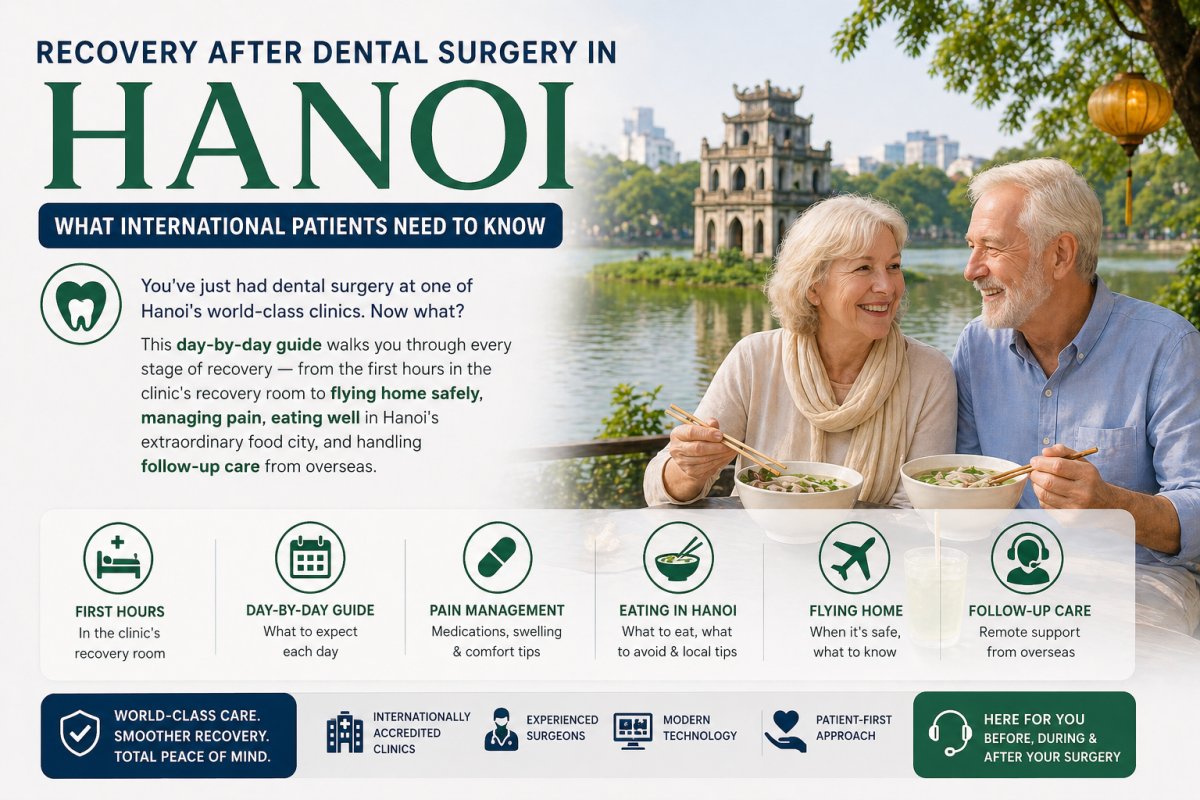
You've just had dental surgery at one of Hanoi's world-class clinics. Now what? This day-by-day guide walks you through every stage of recovery, from the first hours in the clinic's recovery room to flying home safely, managing pain, eating well in Hanoi's extraordinary food city, and handling follow-up care from overseas.
Browse listed Hanoi Clinics →Quick Summary
- Day 1: Rest, cold compresses, bite gauze, soft cold foods only, do NOT rinse
- Days 2–3: Swelling peaks, pain drops to manageable levels, start gentle rinsing
- Days 4–7: Significant improvement; warm soft foods okay; short sightseeing walks fine
- Week 2: Most patients feel 80–90% normal; sutures dissolve or are removed
- Weeks 3–4: Return to near-normal diet; implant osseointegration begins
- Months 2–3: Follow-up X-ray confirms healing; permanent crowns fitted (if applicable)
- Flying home: Wait 72 hours minimum (5–7 days for complex procedures)
Why Hanoi Is an Ideal Place to Recover From Dental Surgery
Hanoi is not just one of Southeast Asia's most affordable dental tourism destinations, it's also one of the most comfortable cities in the world to recover in. Here's why tens of thousands of international patients choose to spend their recovery days here rather than rushing straight home.
1. The Food Is Perfect for Dental Recovery
Vietnamese cuisine is naturally soft, brothy, and easy to eat post-surgery. Cháo (rice porridge), phở broth, silken tofu, steamed fish, and chè desserts are served everywhere, from five-star hotels to street stalls open at 2 a.m. You'll never struggle to find a recovery-friendly meal in Hanoi. See our dedicated post-surgery food guide for Hanoi for a full day-by-day meal plan.
2. World-Class Clinics With International Aftercare Standards
Hanoi's leading clinics, including Picasso Dental, Westcoast International, Australian Dental, Home Dental, and Global Dental, all offer structured post-operative programs: same-day follow-up calls, in-person check appointments at 24–48 hours, written recovery instructions in English, and WhatsApp video consultations after you fly home. This is a level of care that rivals or exceeds what most patients receive from their home dentist.
3. Affordable Hotels Near Top Clinics
You can stay in a 4-star hotel near Hoan Kiem Lake, walking distance from Old Quarter and Westlake clinics, for $40–80 USD per night. That's half the cost of a Western hospital's day rate. Staying 5–7 extra days for proper recovery adds minimal cost compared to the $4,000–$12,000 saved on treatment.
4. Low-Stress Environment Aids Healing
Hanoi's café culture, lakeside walks, museums, and Old Quarter browsing make it easy to stay relaxed without straining your body. For more ideas, read our guide on combining a Hanoi holiday with dental treatment.
Day 1: The First 24 Hours After Dental Surgery
The first 24 hours are the most critical for a smooth recovery. Your body is in its peak inflammatory response, bleeding is normal, swelling is beginning, and pain is typically at its highest. Here is exactly what to expect and do.
At the Clinic (Hours 0–2)
- You'll spend 30–60 minutes in the clinic's recovery area while anaesthesia wears off
- A nurse will show you how to bite firmly on sterile gauze to control bleeding
- You'll receive written post-op instructions in English and your medication pack
- The clinic will book your 24–48 hour follow-up appointment before you leave
- Do not eat or drink until the numbness has fully worn off (typically 2–4 hours)
Back at Your Hotel (Hours 2–24)
Pain Level: 4–6/10. Expect aching, pressure, and tenderness.
- Ice packs: Apply to the outside of your face in 20-minute on/off cycles for the first 6 hours, this dramatically reduces swelling
- Elevation: Keep your head elevated, use an extra pillow; do not lie flat
- Do NOT rinse: Absolutely no rinsing, spitting, or using a straw for 24 hours, this dislodges the blood clot and causes dry socket
- Do NOT smoke: Smoking is the single biggest cause of implant failure and dry socket
- Medications: Take your prescribed antibiotics with food; take ibuprofen (400–600 mg) and paracetamol (1,000 mg) as directed, do not wait until pain is severe
- Food: Cold soft foods only, smoothies, chilled yoghurt, cold congee, ice cream (no nuts or crunchy toppings)
- Hydration: Drink plenty of water, sip gently, never use a straw
Sleep on Day 1
Sleep with your head elevated on two pillows. Some patients find putting a towel over their pillow helpful in case of minor overnight bleeding. Light pinkish saliva for 12–24 hours is normal. Heavy bright-red bleeding that soaks through gauze repeatedly is not, call your clinic's emergency number.
Day 1 Warning Signs, Call Your Clinic Immediately:
- Bright red bleeding that will not stop after 30–45 minutes of firm gauze pressure
- Severe chest pain or difficulty breathing (rare allergic reaction to anaesthesia)
- Complete numbness on one side of your face 6+ hours after surgery
Days 2–3: Swelling Peaks, Pain Begins to Subside
Days 2 and 3 are typically when swelling reaches its maximum, this is entirely normal and expected, especially after implant surgery, bone grafting, or extractions. Most patients are surprised that swelling is worse on Day 2 than Day 1. The good news: pain levels drop significantly on Day 2 as the inflammation response stabilises.
Pain Level: 3–4/10. Uncomfortable but manageable with over-the-counter medications.
Your 24–48 Hour Follow-Up Appointment
Most Hanoi clinics schedule a complimentary check-up at 24–48 hours. The dentist will inspect the surgical site, remove any excess gauze or sutures that are causing irritation, check your bite, and address any concerns. This is included in your treatment fee at all 7 clinics listed in this guide.
Starting Gentle Salt-Water Rinsing
From 24 hours post-surgery, you can begin very gentle warm salt-water rinsing (1/4 teaspoon of salt in a glass of warm water). Do NOT swish aggressively, let it sit in your mouth and gently tilt your head to move it around, then let it fall out. Do this 3–4 times daily after meals. Never spit forcefully.
Switching From Cold to Warm Compresses
After 48 hours, switch from ice packs to warm damp cloths applied to your face. This helps disperse swelling and promotes blood flow to aid healing.
Diet on Days 2–3
Continue with soft, cool-to-warm foods. Avoid extremes of temperature, no piping hot pho broth yet. Good options: room-temperature cháo, steamed eggs, soft tofu, banana, avocado, lukewarm broth, yoghurt, and smoothies. Avoid chewing on the side of the surgery.
Activity on Days 2–3
Rest is still paramount. Short, gentle walks (15–20 minutes flat terrain) are fine and actually beneficial for circulation. Do not exercise, bend over repeatedly, or lift heavy bags. The Old Quarter has many ground-floor cafés and air-conditioned shopping areas perfect for gentle, low-exertion time.
Days 4–7: Turning the Corner, Significant Improvement
By Day 4, most patients report feeling dramatically better. Swelling begins to visibly decrease, the surgical site starts closing over, and energy levels return. Many patients are ready to enjoy light sightseeing and explore Hanoi's extraordinary culture.
Pain Level: 1–3/10. Most patients need only occasional paracetamol by Day 5.
Expanding Your Diet (Days 4–7)
You can now progress to warm soft foods, just cooked pho noodles (cut short), steamed fish, soft rice, scrambled eggs, steamed dumplings (bánh cuốn), and well-cooked vegetables. Avoid: hard crusty bread, seeds, nuts, crunchy vegetables, and sticky foods like toffee or glutinous rice.
Oral Hygiene from Day 4
Resume gentle tooth brushing with a soft-bristle brush, carefully avoiding the surgical site. Use the prescribed medicated mouthwash (chlorhexidine) if provided, do NOT use alcohol-based commercial mouthwash as it irritates healing tissue. Continue salt-water rinses 3x daily.
What You Can Do in Hanoi on Days 4–7
- Hoan Kiem Lake lakeside walk (flat, shaded, very relaxing)
- Temple of Literature (minimal walking, air-conditioned gift shop)
- Old Quarter café hopping, Hanoi's egg coffee (cà phê trứng) is smooth and soft-food friendly
- Ho Chi Minh Mausoleum grounds (gentle walking)
- Cooking class focused on soft Vietnamese dishes
Avoid: bumpy motorbike tours, intense heat exposure, and alcohol (it thins blood and delays healing). Read our full Hanoi holiday + dental treatment itinerary for day-by-day activity ideas timed to your recovery.
Suture Check (Day 5–7)
Many clinics schedule a 5–7 day suture check. If dissolvable sutures were used, they'll be assessed and any loose ones trimmed. If non-dissolvable sutures were used, they'll typically be removed at this appointment.
Week 2: Sutures Out, Energy Returns
By Week 2 (Days 8–14), the vast majority of patients feel 80–90% back to normal. External bruising has fully resolved for most people, swelling is gone, and the surgical site has a pink, healthy-looking tissue layer over it.
Pain Level: 0–1/10. Most patients need no pain medication by Day 10.
Diet in Week 2
Progress to a broader range of soft foods. You can now eat normally cooked pho with regular-sized noodles, soft bánh mì (remove any crusty exterior), soft-cooked meat, and most Vietnamese dishes, just avoid chewing directly on implant sites or extraction sockets.
If You're Still in Hanoi
Week 2 is a great time to explore further, day trips to Ha Long Bay, Ninh Binh, or Tam Coc are all appropriate if your surgeon has given clearance. Avoid very bumpy long-distance bus journeys; opt for trains or private transfers. See our Hanoi travel itinerary for dental patients for specific recommendations.
If You've Flown Home
If you flew home between Days 3–7, you should schedule a check-up with your home dentist or GP at the 2-week mark. Show them your treatment records from Hanoi. Most home dentists are familiar with the quality of major Vietnamese dental clinics and can confirm normal healing from a visual inspection and X-ray.
Weeks 3–4: Near-Normal Life Resumes
By the end of Week 3, soft tissue healing is essentially complete for most procedures (extractions, simple implants, crowns, veneers). You can return to your normal diet with the exception of very hard foods (ice cubes, hard candy, crusty baguette) chewed on the implant side.
Exercise Resumption
- Week 3: Light cardio (walking, cycling, swimming, but avoid vigorous laps) is fine
- Week 4: Most forms of exercise can be resumed. Avoid full-contact sports for 6 weeks post-implant surgery
- Do not use a custom mouthguard over implant healing caps, check with your surgeon first
Osseointegration: What's Happening Under the Surface
If you had dental implants placed, the titanium post is now beginning to osseointegrate, fuse directly with your jawbone. This process takes 3–6 months and happens silently. You won't feel it, but it is the critical phase that determines long-term implant success. During this period, avoid smoking, maintain excellent oral hygiene, and attend your scheduled remote check-in with the Hanoi clinic.
Months 2–3: Implant Integration Confirmed, Final Crowns Fitted
At 2–3 months post-surgery, your Hanoi clinic will typically schedule a remote review (WhatsApp video + X-ray photos taken by your home dentist and emailed over). If osseointegration is confirmed successful, the clinic will either:
- Fit a permanent crown remotely with a partnering local dentist (using the digital specs sent from Hanoi), OR
- Invite you back to Hanoi for the crown-fitting appointment (many patients combine this with another holiday)
Long-Term Implant Success Rates
Dental implants placed with internationally certified brands (Straumann, Nobel Biocare, Osstem) at listed Hanoi clinics carry the same 10–15 year clinical success rates (95–98%) as implants placed in Australia, the UK, or the US. The implant's outcome is determined by the quality of the titanium, the surgeon's technique, and your healing, not the country where it was placed.
For a complete breakdown of implant options in Hanoi, read our dental implants in Hanoi complete guide and our All-on-4 implants Hanoi guide.
Ready to Plan Your Hanoi Dental Treatment?
Compare listed clinics, read real patient reviews, and get transparent pricing, all in one place.
Explore Hanoi Clinics on SmileJet →7 Hanoi Clinics With Exceptional Post-Surgery Aftercare Programs
The quality of aftercare is just as important as the surgery itself. These seven Hanoi clinics were selected specifically because of their structured post-operative programs, English-language communication, and documented commitment to international patient aftercare.
Picasso Dental Clinic, Old Quarter Branch
⭐ 4.9/5 · 1,240 reviews · Est. 2011
Post-op support: 24-hour emergency hotline, complimentary 24h and 7-day follow-up appointments, WhatsApp video consultations post-departure, English-language discharge summary with implant specifications
Why #1: Hanoi's most-reviewed international clinic with the largest post-op nursing team dedicated to recovery support
View SmileJet Profile →Picasso Dental Clinic, Westlake Square Branch
⭐ 4.9/5 · 876 reviews · Est. 2017
Post-op support: Dedicated international patient coordinator available 7 days/week, structured 5-step recovery protocol, digital recovery diary sent to patients on Day 1, telemedicine follow-ups
Why #2: Quieter Westlake location is ideal for recovery patients, less noise, more comfortable post-op environment close to lakeside walking paths
View SmileJet Profile →Westcoast International Dental Clinic, West Lake
⭐ 4.8/5 · 634 reviews · Est. 2009
Post-op support: Post-op medication pack included in treatment price, 48h nurse call-back, written recovery protocol in 4 languages (English, French, Korean, Vietnamese), partnered with local pharmacies for same-day medication delivery
Why #3: Longest-established international-standard clinic in Hanoi with the most comprehensive post-operative medication management program
View SmileJet Profile →Australian Dental Clinic Hanoi
⭐ 4.9/5 · 512 reviews · Est. 2014
Post-op support: Australian-trained lead dentists provide post-op consultations, flying clearance certificates for insurance purposes, direct email line to treating surgeon for 30 days post-treatment
Why #4: Australian-standard clinical protocols and direct surgeon access make this the preferred choice for Australian and New Zealand patients who need seamless continuity of care back home
View SmileJet Profile →Home Dental Clinic Hanoi
⭐ 4.8/5 · 428 reviews · Est. 2012
Post-op support: Personalised recovery plan tailored to each patient's procedure and travel schedule, hotel concierge partnership for medication delivery and ice pack supply, 24h WhatsApp number for recovery questions
Why #5: Renowned for its patient-centric recovery approach, staff proactively check in with international patients each evening for the first 3 days post-surgery
View SmileJet Profile →Global Dental Clinic Hanoi
⭐ 4.8/5 · 389 reviews · Est. 2015
Post-op support: Digital X-ray copies emailed to patient within 2 hours of surgery, structured 3-month remote follow-up schedule, free re-consultation within 12 months if you return to Hanoi
Why #6: Best documentation standards in Hanoi, the full treatment record package they provide is designed to be shared directly with your home country specialist
View SmileJet Profile →Greenfield Dental Clinic Hanoi
⭐ 4.7/5 · 276 reviews · Est. 2016
Post-op support: Soft-food restaurant recommendations package given to every post-op patient, hotel tie-ins for recovery room upgrades, translated prescription service for international pharmacies
Why #7: Greenfield's unique "recovery concierge" approach extends beyond the clinic, coordinating hotel, pharmacy, and soft-food delivery for the most comfortable possible recovery experience
View SmileJet Profile →Pain Management: Medications Available in Hanoi
Hanoi has an excellent pharmacy network. Licensed pharmacies (nhà thuốc) are found on virtually every block in the tourist areas, and many pharmacists speak basic English. All post-surgical medications prescribed by Hanoi clinics are available without the delays and costs you might encounter at home.
| Medication | Purpose | Typical Dose | Cost in Hanoi |
|---|---|---|---|
| Amoxicillin 500mg | Antibiotic, prevents infection | 3x daily for 5–7 days | $3–5 USD for full course |
| Metronidazole 250mg | Antibiotic (penicillin allergy alternative) | 3x daily for 5–7 days | $3–6 USD for full course |
| Ibuprofen 400mg | Anti-inflammatory pain relief | 3x daily with food, Days 1–5 | $1–2 USD for 20 tablets |
| Paracetamol (Panadol) 500–1000mg | Breakthrough pain relief | Up to 4x daily, max 4g/day | $1 USD for 20 tablets |
| Chlorhexidine Mouthwash | Antibacterial mouth rinse | 2x daily from Day 2 | $3–5 USD per bottle |
| Sterile Gauze Pads | Bleeding control (Day 1) | As directed | $1–2 USD per pack |
Important: Do NOT take aspirin for post-dental pain, it is a blood thinner and will worsen bleeding. Avoid combining ibuprofen and alcohol. Always complete the full antibiotic course even if you feel better after Day 3.
Complete Diet Guide: What to Eat in Hanoi During Dental Recovery
Hanoi's cuisine naturally accommodates post-dental recovery. Here is a phase-by-phase breakdown of what to eat and avoid, with specific Vietnamese dishes that are safe and delicious at each stage. For the full restaurant guide with neighbourhood recommendations, see our dedicated what to eat after dental surgery in Hanoi guide.
| Recovery Stage | Eat This | Avoid This |
|---|---|---|
| Day 1 (cold/room temp only) | Cold cháo, smoothies, yoghurt, ice cream (plain), chilled silken tofu, avocado | Anything hot, hard, crunchy, or chewy; straws; alcohol |
| Days 2–3 (cool/warm soft) | Warm cháo, steamed eggs, soft tofu, banana, lukewarm broth, mashed potato, soft noodles (cut short) | Hot soups, seeds, nuts, chewy meats, alcohol, coffee |
| Days 4–7 (soft expanded) | Phở (soft noodles, cut), bánh cuốn (steamed rice rolls), steamed fish, scrambled eggs, soft rice, ripe fruit | Crusty bread, hard vegetables, sticky rice, raw vegetables |
| Week 2 (near-normal soft) | Most Vietnamese dishes cut small, soft bánh mì (inside only), cooked vegetables, tender meats | Hard candy, ice cubes, crusty textures chewed on surgery side |
| Weeks 3–4 (return to normal) | Normal diet with care around implant sites | Very hard foods on implant side for 3–6 months |
Flying Home: When It's Safe and What to Expect
Flying after dental surgery is one of the top concerns for international patients in Hanoi. The short answer: most patients can fly safely within 72 hours for simple procedures, or 5–7 days for complex surgery. Here's a procedure-specific breakdown.
| Procedure | Minimum Wait to Fly | Recommended Wait |
|---|---|---|
| Simple extraction (1–2 teeth) | 24–48 hours | 48–72 hours |
| Crown or veneer fitting | Same day (no surgery) | 24 hours (allow cement to fully set) |
| Single dental implant | 72 hours | 5 days |
| All-on-4 / All-on-6 | 5 days | 7 days |
| Bone graft / sinus lift | 5 days | 7–10 days |
| Multiple extractions + implants | 5 days | 7–10 days |
Tips for the Flight Home
- Take ibuprofen 1 hour before your flight if swelling is still present, cabin pressure changes can increase discomfort
- Stay well hydrated, dry cabin air slows healing
- Avoid alcohol on the flight, it thins blood and dehydrates you
- Pack your post-op instructions in your carry-on in case of questions at the airport
- Request an aisle seat, you'll be getting up frequently to move and hydrate
- Tell the flight attendant you've had dental surgery if you're concerned about any pain
For a comprehensive guide on flying from Hanoi after dental treatment, see our Hanoi dental tourism packing list which covers what to pack in your medical carry-on bag.
Red Flags: When to Seek Emergency Care in Hanoi
The vast majority of dental recoveries are smooth and complication-free. However, knowing what's normal versus what requires urgent attention gives you peace of mind and can prevent minor issues from becoming serious. If you have dental implants, our companion guide on why implants fail and what warning signs to watch for is essential reading before you fly home.
Normal (No Action Needed)
- Pink-tinged saliva for 24 hours
- Moderate swelling peaking on Day 2
- Bruising on cheek or jaw (Days 2–5)
- Mild to moderate aching (4/10 or less by Day 3)
- Stiffness of jaw when opening wide
- Mild sensitivity to hot/cold
- Suture threads feeling loose on Day 5+
Red Flags, Call Clinic Immediately
- Bleeding not controlled by 30 min gauze pressure
- Fever above 38.5°C (101.3°F)
- Severe worsening pain after Day 3
- Visible pus or foul taste at site
- Numbness persisting beyond 48 hours
- Swelling spreading to throat or neck
- Difficulty breathing or swallowing
Dry Socket: The Most Common Complication
Dry socket (alveolar osteitis) occurs when the blood clot in an extraction socket dislodges prematurely, exposing the bone. It affects approximately 2–5% of extractions. Symptoms: severe, throbbing pain radiating to the ear starting on Day 3–4, after initial improvement. Treatment is simple, your Hanoi clinic will clean the socket and pack it with medicated dressing within minutes. Do not ignore it; it's painful but very easily treated.
Emergency Contacts in Hanoi
- Your clinic's 24h hotline, the most important number; save it before you leave the clinic on Day 1
- Viet Duc Hospital, 40 Tràng Thi Street, Hoàn Kiếm District; has an English-speaking emergency department
- Bach Mai Hospital, 78 Giải Phóng, Đống Đa; largest public hospital in Hanoi
- Vietnam National Emergency Number: 115 (ambulance)
For any dental emergency in Hanoi, contact your clinic's 24-hour hotline first. Viet Duc Hospital (40 Tràng Thi Street) and Bach Mai Hospital (78 Giải Phóng) both have English-speaking emergency departments.
Managing Follow-Up Care From Home After Returning From Hanoi
One of the most common concerns among international dental patients is: what happens if something goes wrong after I get home? The good news is that Hanoi's top clinics are well-equipped for remote aftercare, and the process is straightforward.
Before You Leave the Clinic: What to Request
- Full treatment summary in English including procedure performed, materials used (implant brand, model number, crown material), medications prescribed
- Pre- and post-operative X-rays (digital copies emailed to you)
- Implant specifications card (implant brand, length, diameter, batch number), critical if you ever need work on this implant abroad
- Clinic's WhatsApp number and email for follow-up contact
- Written flying clearance certificate if your clinic offers one (useful for travel insurance)
- Recommended follow-up timeline (e.g., 2-week, 6-week, 3-month, 6-month check-ins)
The Remote Follow-Up Protocol
| Timeline | What Happens | How |
|---|---|---|
| Week 2 | Soft tissue healing confirmed | WhatsApp photo sent to clinic or home dentist check-up |
| Week 6 | Early osseointegration check | X-ray at home dentist; email or WhatsApp to Hanoi clinic for review |
| Month 3 | Osseointegration assessment; crown fitting decision | Video call with Hanoi surgeon + X-ray review |
| Month 6 | Final integration confirmed; long-term maintenance plan | Home dentist check-up; X-ray shared with Hanoi clinic |
For detailed step-by-step planning guidance on the full Hanoi dental journey from booking to follow-up, read our step-by-step Hanoi dental trip planning guide.
Frequently Asked Questions: Recovery After Dental Surgery in Hanoi
Start Planning Your Hanoi Dental Treatment Today
Compare listed clinics, read real patient reviews, check transparent pricing, and get personalised guidance from SmileJet's dental tourism specialists.
Browse Hanoi Clinics on SmileJet →Medical Disclaimer
The information in this guide is provided for general educational purposes only and does not constitute medical advice. Recovery timelines, pain levels, and medication recommendations vary by individual, procedure complexity, and overall health. Always follow the specific post-operative instructions provided by your treating dental surgeon in Hanoi, and consult a qualified medical professional for any concerns about your recovery. SmileJet is a dental tourism information and comparison platform and does not provide medical treatment.
Prices are indicative; only a clinic's written quote applies to you. See how we source prices. SmileJet is an information service, not a healthcare provider, and nothing here is medical advice.
Want this priced for your own mouth? Send a photo and we will come back with written quotes from clinics that fit.
Get my quoteIf you are also looking at treatment
What it costs, and who does it.
Published clinic fees, not estimates. Indicative until a clinic puts a quote in writing.
Dental care in Hanoi
Prices, clinics and how a treatment trip there actually works.
Dental implants in Hanoi
What a single implant costs there, and which systems the clinics use.
Veneers in Hanoi
Composite, E.max and zirconia, with the price each clinic publishes.
All-on-4 in Hanoi
Full-arch pricing, how many trips it takes, and who handles the complex cases.
Keep reading
Related guides.
Questions to ask a Cuenca dentist before you book
Twelve questions that separate a quote you can rely on from one you cannot. Ask them before you book flights.
How long to stay in Cuenca for dental implants
The honest answer is two trips, months apart. Here is what each one involves and why it cannot be compressed.
Getting to Cuenca for dental work
Cuenca has its own airport but few international patients land there directly. How the routes actually work.
Send a photo. Get three quotes.
It costs nothing and it does not commit you to anything. Most people hear back the same day.