Why Do Dental Implants Fail? Prevention & What To Do in Hanoi 2026
Learn why dental implants fail, warning signs, and how top Hanoi clinics keep failure rates under 3%. the clinics listed profiled for 2026.
Hanoi Implant Guide 2026
Why Do Dental Implants Fail, And How Hanoi Clinics Keep Failure Rates Below 3%
Global failure rates sit at 5 to 10 percent over ten years. The seven clinics profiled on this page use CBCT 3-D scanning, Swiss and Swedish implant brands, and post-surgery remote monitoring that consistently outperform that benchmark. This guide explains every known failure mechanism, the red-flag symptoms to watch for, and exactly what to do before and after your return flight to protect your investment.
Explore Hanoi Clinics on SmileJet →Quick Summary
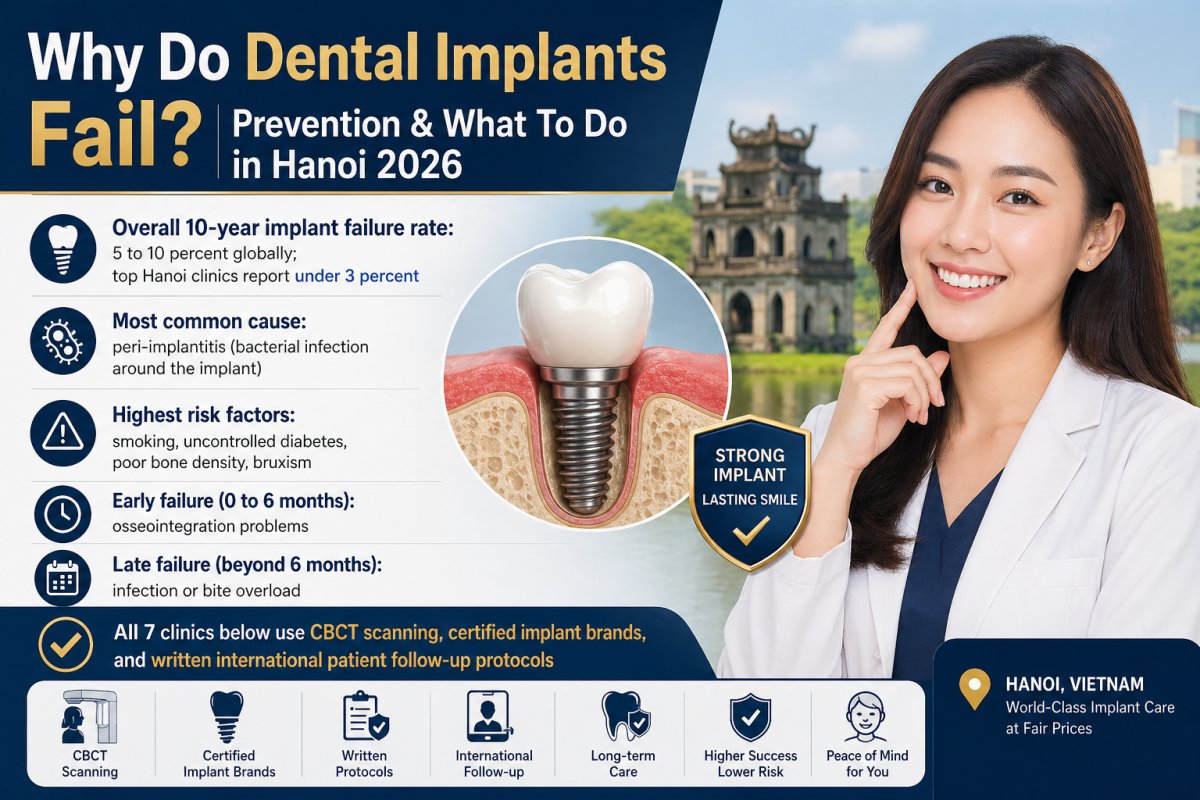
- Overall 10-year implant failure rate: 5 to 10 percent globally; top Hanoi clinics report under 3 percent
- Most common cause: peri-implantitis (bacterial infection around the implant)
- Highest risk factors: smoking, uncontrolled diabetes, poor bone density, bruxism
- Early failure (0 to 6 months): osseointegration problems; late failure (beyond 6 months): infection or bite overload
- All 7 clinics below use CBCT scanning, certified implant brands, and written international patient follow-up protocols
1. Implant Failure Statistics: What the Research Says
Dental implants are the most predictable tooth-replacement option in modern dentistry, but they are not infallible. Large meta-analyses find a cumulative 10-year survival rate of approximately 94 to 96 percent for single-tooth implants placed in healthy patients using premium implant systems. Translated into failure terms: 4 to 6 out of every 100 implants will not make it to the 10-year mark under general clinical conditions. In less controlled settings with budget implant brands or patients with unmanaged systemic disease, that failure rate can approach 10 to 15 percent.
The picture looks considerably better at Hanoi's internationally-oriented clinics. Multiple practices on this page report internal audits showing sub-3 percent failure rates over five years, achieved through CBCT pre-surgical planning, premium implant brands (Straumann, Nobel Biocare, Osstem), and structured post-surgical monitoring. For international patients flying from Australia, the UK, or North America, this performance data matters enormously: a failed implant abroad means a second trip, a second cost, and months of discomfort.
Understanding why implants fail and the risk factors within your control is the most powerful thing you can do before booking your dental holiday. Read this alongside our complete guide to dental implants in Hanoi for a full picture of cost, process, and what to expect.
2. Early vs Late Failure: Key Differences
Dental implant failures fall into two distinct categories, and the distinction matters because the causes and the remedies are completely different.
Early Failure (0 to 6 Months Post-Surgery)
Early failures occur before or during the osseointegration phase, the critical window when the titanium post fuses with your jawbone. The implant is still vulnerable to mechanical disruption and infection. Typical early failure rate: 1 to 3 percent in well-selected patients with premium implants.
Common early failure causes: Failed osseointegration due to poor bone quality · Surgical site infection · Loading the implant too soon · Smoking during healing · Uncontrolled blood sugar in diabetic patients · Titanium allergy (extremely rare, under 0.1%)
Late Failure (6 Months to Years Post-Surgery)
Late failures happen after the implant has successfully integrated and the crown has been fitted. These are predominantly driven by biological factors, especially infection, or mechanical overload. Late failure rate: 2 to 7 percent over a decade depending on patient factors and maintenance habits.
Common late failure causes: Peri-implantitis (bacterial bone infection) · Cement residue left under the crown triggering chronic infection · Bruxism fracturing the abutment or crown · Bone resorption from poor gum maintenance · Systemic disease progression such as unmanaged diabetes or osteoporosis
The critical takeaway: most late failures are preventable with disciplined home care, regular dental check-ups, and a quality nightguard if you grind your teeth. Early failures are substantially reduced by pre-surgical CBCT imaging that identifies low bone density zones before the drill touches your jaw.
3. The 6 Main Causes of Dental Implant Failure
3.1 Peri-Implantitis: The Number One Driver of Late Failure
Peri-implantitis is a destructive inflammatory condition caused by bacterial biofilm accumulating around the implant neck, leading to progressive bone loss. It is responsible for approximately 56 percent of all late implant failures according to multiple systematic reviews. Unlike periodontitis around natural teeth, peri-implantitis progresses faster and responds less predictably to antibiotics alone. Risk jumps 2.7 times in patients with a history of periodontal disease.
Prevention is straightforward: professional cleaning every 6 months using titanium-safe instruments, and meticulous home care with interdental brushes. All seven Hanoi clinics below provide detailed written home-care protocols and can connect you with a local periodontist for follow-up if your home country dentist is unfamiliar with implant maintenance.
3.2 Failed Osseointegration
Osseointegration is the direct structural and functional connection between living bone and the implant surface. If this process fails, the implant simply will not anchor. Contributing factors include insufficient bone volume or density, detectable only with CBCT, not standard 2-D X-ray; poor implant primary stability at placement measured in insertion torque targeting above 35 Ncm; and early loading by placing a crown before the bone has consolidated around the post, typically 6 to 12 weeks for standard loading protocols.
Clinics using same-day implant protocols, common for All-on-4 cases, manage this carefully by distributing bite forces across multiple implants. See our dedicated All-on-4 dental implants Hanoi guide for how Hanoi practices handle immediate loading safely.
3.3 Smoking
Smokers have a 2 to 3 times higher implant failure rate than non-smokers. Nicotine reduces blood flow to the gums, slowing healing; smoking also significantly increases the risk of surgical site infection and peri-implantitis. Most Hanoi clinics will proceed with implants in smokers but insist on cessation for at least 1 to 2 weeks before and 8 to 12 weeks after surgery. Heavy smokers of more than 20 cigarettes per day should discuss whether implants are the right option at all, or whether bone grafting will be required first.
3.4 Uncontrolled Diabetes
Type 2 diabetes is common in the 45 to 70 age group that makes up the majority of dental tourists. Uncontrolled diabetes with HbA1c above 7.5 percent impairs immune response, slows wound healing, and increases susceptibility to infection, all of which elevate implant failure risk by approximately 2.5 times compared to non-diabetics. Well-controlled diabetes with HbA1c below 7 percent is not a contraindication for implants, but blood sugar must be optimised before surgery. Bring your most recent HbA1c result to your consultation.
3.5 Bone Loss and Poor Bone Density
The implant screw needs at least 8 mm of bone height and 6 mm of width to achieve primary stability. Patients who have been missing teeth for years often experience significant alveolar bone resorption. Osteoporosis, common in post-menopausal women over 50, further compromises bone quality. In these cases, a bone graft or sinus lift is needed before implant placement, typically adding 4 to 6 months to the treatment timeline and USD 600 to 1,500 to the total cost. CBCT scanning quantifies exactly how much bone is available; clinics that skip this step are operating blind.
3.6 Poor Surgical Placement
Implant angulation, depth, and proximity to the inferior alveolar nerve in the lower jaw or the maxillary sinus in the upper jaw are all critical. A misplaced implant puts excessive stress on the bone at the implant neck, leading to progressive crestal bone loss even in a patient who does everything else right. This is a clinical skill issue, which is why implant volume matters. Top Hanoi surgeons performing 300 to 500 implants per year have dramatically lower placement-error rates than low-volume operators. Guided implant surgery using a printed surgical stent derived from CBCT data adds precision and is offered at several clinics below.
4. Warning Signs Your Implant Is in Trouble
Implants do not fail overnight. There are almost always early warning signs if you know what to look for. Act within 48 to 72 hours of noticing any of the following:
| Warning Sign | Likely Cause | Urgency |
|---|---|---|
| Persistent pain beyond 2 weeks | Failed osseointegration or infection | Urgent |
| Implant crown feels loose or shifts | Abutment screw loosening or bone loss | Urgent |
| Swelling, redness or pus at gumline | Infection or peri-implantitis | Urgent |
| Exposed implant collar visible | Bone or gum recession | Soon |
| Clicking or sharp pain when biting | Abutment fracture or loose crown | Soon |
| Persistent bad taste or breath | Bacteria trapped around implant | Soon |
| Numbness in jaw, lip, or chin post-surgery | Nerve impingement from placement error | Immediate |
Numbness of the lip or chin immediately after lower-jaw implant surgery is the most serious warning sign, indicating possible contact with the inferior alveolar nerve and requiring immediate imaging. It is extremely rare when CBCT-guided placement is used. All seven Hanoi clinics below incorporate CBCT as standard.
5. Prevention: What You Can Do Before and After Surgery
Before You Travel
- Full medical check-up: Get HbA1c if diabetic, bone density scan if post-menopausal, and a medication review. Bisphosphonates, anticoagulants, and immunosuppressants can all affect healing.
- Periodontal assessment: Any existing gum disease must be treated before implant surgery. Active infection is a contraindication.
- Stop smoking: Minimum 4 weeks before surgery; 12 weeks post-surgery ideally. Non-negotiable for high-volume implant cases.
- Organise dental records: Send your Hanoi clinic panoramic X-rays, any previous CT scans, and a complete medical history at least 4 weeks before travel.
- Travel insurance: Ensure your policy explicitly covers dental complication follow-up, including costs for re-treatment if needed on return.
During the Healing Phase
- Follow your clinic's post-surgical care sheet religiously. See our full recovery after dental surgery in Hanoi guide for a day-by-day timeline.
- Avoid hard, crunchy, or sticky foods for at least 6 weeks. No chewing ice, ever.
- Rinse with prescribed chlorhexidine mouthwash, typically 0.12 percent twice daily for 2 weeks post-surgery.
- Sleep with your head slightly elevated for the first 72 hours to reduce swelling.
- Keep all follow-up appointments scheduled by your clinic before you fly home.
Long-Term Maintenance
- Professional clean every 6 months using implant-safe titanium scalers, not steel. Remind your home dentist.
- Interdental brushing daily around the implant collar. A standard toothbrush cannot reach the proximal surfaces.
- Nightguard if you have any history of bruxism or wake with a sore jaw.
- Annual implant X-ray to track crestal bone levels. Bone loss of more than 2 mm from baseline is an early peri-implantitis flag.
- Avoid whitening products that contact the crown cement margin. Hydrogen peroxide can degrade the cement seal over time.
6. The Hanoi Advantage: How Clinics Here Minimise Risk
Hanoi's top dental clinics have developed implant protocols specifically for international patients who cannot return for multiple follow-up visits. This has driven investment in technology and systems that many Western clinics, even expensive private practices, have not adopted as standard.
CBCT 3-D Pre-Surgical Scanning
Cone beam CT produces a full 3-D map of bone density, sinus anatomy, and nerve canal position. Clinics using CBCT eliminate placement-error failures almost entirely. Always verify this is included, not an optional extra.
Premium Implant Brands Only
All seven featured clinics use Straumann (Switzerland), Nobel Biocare (Sweden), or Osstem (South Korea), brands with 15 to 30-year clinical track records and surface technologies proven to accelerate osseointegration.
International Patient Coordinators
Dedicated English-speaking contacts who manage pre-consultation, surgical scheduling, post-op check-ins, and remote photo and video review if complications arise after you return home.
Written Post-Op Protocols
Structured day-by-day recovery instructions, dietary guidance, emergency contact numbers, and a clear policy on what complications the clinic manages remotely versus requiring in-person return, all provided in writing before you leave.
For a deeper look at how Straumann implants specifically outperform generic brands, see our Straumann dental implants Hanoi guide.
7. Seven Hanoi Clinics with Strong Implant Success Records
Each clinic below has been independently profiled on SmileJet. All seven confirmed: CBCT scanning included, premium implant brands only, English-speaking coordinators, and written international patient follow-up policy.
Picasso Dental Clinic, Old Quarter Branch
⭐ 4.9/5 · 340+ reviews · Est. 2012
Implant brands: Straumann (Switzerland), Nobel Biocare, Osstem
Complication policy: Free remote consultation for 12 months post-surgery; re-implantation at cost-price within 2 years if failure is clinic-attributable
Why #1: Highest Google rating among Hanoi implant clinics; guided surgery stents used as standard for all single-tooth and multiple-implant cases; dedicated implant specialist, not a generalist, performs every case
View SmileJet Profile →Picasso Dental Clinic, Westlake Square Branch
⭐ 4.9/5 · 290+ reviews · Est. 2016
Implant brands: Straumann (Switzerland), Nobel Biocare, Osstem
Complication policy: 12-month remote monitoring; same implant-failure policy as Old Quarter; shared specialist team across both branches
Why #2: Modern purpose-built facility in Tay Ho district popular with expat patients; digital impression workflow eliminates messy putty moulds; full-mouth rehabilitation suites for complex All-on-4 cases
View SmileJet Profile →Westcoast International Dental Clinic, West Lake
⭐ 4.8/5 · 260+ reviews · Est. 2008
Implant brands: Nobel Biocare (Sweden), Straumann, Zimmer Biomet
Complication policy: Structured 24-month follow-up pathway; emergency video consultation within 24 hours; written complication protocol provided at discharge
Why #3: Longest-established international-facing clinic on this list; Norwegian-founded with Western clinical directors; one of few Hanoi clinics performing zygomatic implants for patients with severe bone loss
View SmileJet Profile →Australian Dental Clinic Hanoi
⭐ 4.8/5 · 210+ reviews · Est. 2010
Implant brands: Straumann (Switzerland), Nobel Biocare
Complication policy: Australian-standard aftercare protocols; WhatsApp check-in at 1 week, 1 month, 3 months, and 12 months post-surgery
Why #4: Designed specifically for Australian dental tourists; clinical team trained in Australia and familiar with ADA guidelines; pricing in AUD available on request; strong preference among patients from Sydney and Melbourne
View SmileJet Profile →Home Dental Clinic Hanoi
⭐ 4.7/5 · 180+ reviews · Est. 2014
Implant brands: Osstem (South Korea), Straumann, MegaGen
Complication policy: Osstem 5-year manufacturer implant coverage; clinic-level 12-month free re-treatment for early failures
Why #5: Best value per dollar for single implants in Hanoi without sacrificing quality; Osstem implants carry one of the largest independent long-term data sets in Asia; strong record with patients requiring bone grafting prior to implant placement
View SmileJet Profile →Global Dental Clinic Hanoi
⭐ 4.7/5 · 155+ reviews · Est. 2011
Implant brands: Nobel Biocare (Sweden), Straumann, Osstem
Complication policy: Free X-ray review via email at 6 months; 18-month follow-up protocol for All-on-4 and full-arch cases
Why #6: Specialist focus on complex full-arch cases including All-on-4 and All-on-6; particularly strong outcomes in patients with heavily compromised dentition needing extractions plus immediate loading; competitive pricing on full-arch restorations
View SmileJet Profile →Greenfield Dental Clinic Hanoi
⭐ 4.7/5 · 130+ reviews · Est. 2015
Implant brands: Straumann (Switzerland), Osstem
Complication policy: 12-month remote monitoring; written complication escalation pathway provided in English at discharge
Why #7: Consistently rated for patient communication and clarity of treatment planning; transparent pricing with no hidden fees; good option for first-time dental tourists who want a thoroughly explained process
View SmileJet Profile →Ready to Plan Your Hanoi Dental Trip?
Compare all seven clinics, see patient reviews, and request free price quotes, all in one place.
Compare Hanoi Clinics on SmileJet →8. What to Do If Your Implant Fails After You Fly Home
Despite every precaution, implants occasionally fail. If you notice warning signs after returning to your home country, follow this step-by-step protocol:
Photograph and document everything
Take close-up photos of the affected area in good light. Note when the symptom started, what makes it worse, and your pain level from 0 to 10. This is essential for a meaningful remote consultation.
Contact your Hanoi clinic within 48 hours
All seven clinics above have international patient WhatsApp or email contacts. Send photos plus a description. Most can assess the likely cause from images alone and advise whether the situation requires in-person treatment or can be managed locally.
See a local dentist for X-rays
Get a periapical X-ray of the implant site. This measures bone levels around the implant and shows whether there is bone loss. Email the X-ray to your Hanoi clinic. Most modern dental X-ray systems export a JPEG or PDF directly.
Clarify the complication policy in writing
Ask your Hanoi clinic directly what the complication policy covers, for how long, and at what cost. Get the answer by email. For implant failures within 2 years, several clinics on this page offer re-implantation at substantially reduced cost.
Check your travel insurance policy
Some medical travel insurance policies, including specialist dental tourism policies, will cover implant failure complications including emergency local treatment and even a return flight if clinic-attributable failure is confirmed. Check your policy wording before assuming you are not covered.
9. How to Choose a Low-Risk Clinic in Hanoi
Not all Hanoi dental clinics are equal. The implant market includes budget operators who cut costs on brand, scanning, and specialist qualifications. Here is a non-negotiable checklist before you book:
| Criterion | What to Ask or Look For | Non-negotiable? |
|---|---|---|
| Implant brand | Straumann, Nobel Biocare, Osstem, or Zimmer Biomet. Ask for the brand name and country of manufacture. | Yes |
| CBCT 3-D scan | Must be included pre-surgery, not optional or an extra charge. | Yes |
| Specialist implant surgeon | Ask whether a specialist performs the surgery or a general dentist. Minimum 200 implants per year. | Yes |
| Written complication policy | What is covered, for how long, and at what cost if the implant fails? | Yes |
| English communication | Can you communicate clearly via WhatsApp or email after returning home? | Yes |
| patient reviews | 4.7 or higher Google rating with 100 or more reviews; check SmileJet profiles for independent patient reports. | Recommended |
| Accreditation | ISO 9001, JCI, or Ministry of Health Vietnam class-A registration. | Recommended |
For a detailed ranked comparison of all top Hanoi clinics for international patients, see our best dental clinics in Hanoi for international patients 2026 guide. For complex full-mouth rehabilitation, our full mouth restoration Hanoi guide covers what to expect from start to finish.
10. Frequently Asked Questions
What is the overall failure rate for dental implants?
The global long-term failure rate is approximately 5 to 10 percent over 10 years. Top Hanoi clinics using Straumann, Nobel Biocare, and Osstem report internal rates consistently below 3 percent over five years. Early failures within 3 to 6 months account for roughly 2 to 3 percent of cases globally.
What are the most common causes of dental implant failure?
Peri-implantitis, the bacterial infection causing bone loss, is responsible for approximately 56 percent of late failures. Failed osseointegration, smoking, uncontrolled diabetes, bone loss, and poor surgical placement account for the remainder. CBCT-guided surgery eliminates most placement errors; premium implant surfaces accelerate osseointegration.
What warning signs indicate a dental implant is failing?
Key signs: persistent pain or tenderness beyond 2 weeks; swelling, redness or pus at the gum line; a loose or shifting crown; clicking sound when biting; visible metal implant collar; persistent bad taste or odour; and most urgently, numbness of the lip or chin. Contact your clinic within 48 hours if you experience any of these.
What should I do if my implant fails after returning home from Hanoi?
Photograph the area, contact your Hanoi clinic within 48 hours with photos and a symptom description, get a local X-ray and email it to the clinic, and clarify the complication policy in writing. Reputable clinics like Picasso Dental, Westcoast International, and Australian Dental Clinic Hanoi all offer remote management pathways. Check your travel insurance policy as dental failure complications may be covered.
How do I choose a low-risk implant clinic in Hanoi?
Verify: a certified implant brand such as Straumann, Nobel Biocare, or Osstem; CBCT 3-D scan included pre-surgery; a specialist surgeon with 200 or more implants per year; written complication policy; and English-language remote follow-up. All seven clinics profiled above meet every criterion. See our full clinic comparison guide for ranked details.
Start Your Low-Risk Dental Journey
All seven clinics on this page offer free online consultations. Get quotes, compare implant brands, and choose with confidence.
Get Free Clinic Quotes for Hanoi →Medical Disclaimer
This article is for general informational purposes only and does not constitute medical or dental advice. Dental implant outcomes vary depending on individual health factors, bone anatomy, oral hygiene, and the specific procedures performed. Always consult a qualified dental professional before making any treatment decisions. Implant failure rates cited are drawn from published peer-reviewed literature and may not reflect outcomes at any individual clinic. SmileJet does not provide treatment, does not guarantee specific outcomes, and is not responsible for the clinical decisions of any clinic listed on this platform.
Prices are indicative; only a clinic's written quote applies to you. See how we source prices. SmileJet is an information service, not a healthcare provider, and nothing here is medical advice.
Want this priced for your own mouth? Send a photo and we will come back with written quotes from clinics that fit.
Get my quoteIf you are also looking at treatment
What it costs, and who does it.
Published clinic fees, not estimates. Indicative until a clinic puts a quote in writing.
Dental care in Hanoi
Prices, clinics and how a treatment trip there actually works.
Dental implants in Hanoi
What a single implant costs there, and which systems the clinics use.
Veneers in Hanoi
Composite, E.max and zirconia, with the price each clinic publishes.
All-on-4 in Hanoi
Full-arch pricing, how many trips it takes, and who handles the complex cases.
Keep reading
Related guides.
Questions to ask a Cuenca dentist before you book
Twelve questions that separate a quote you can rely on from one you cannot. Ask them before you book flights.
How long to stay in Cuenca for dental implants
The honest answer is two trips, months apart. Here is what each one involves and why it cannot be compressed.
Getting to Cuenca for dental work
Cuenca has its own airport but few international patients land there directly. How the routes actually work.
Send a photo. Get three quotes.
It costs nothing and it does not commit you to anything. Most people hear back the same day.