Dental Tourism
Dental Tourism Safety Checklist for Bogota: 25 Points to Verify Before You Fly (2026)
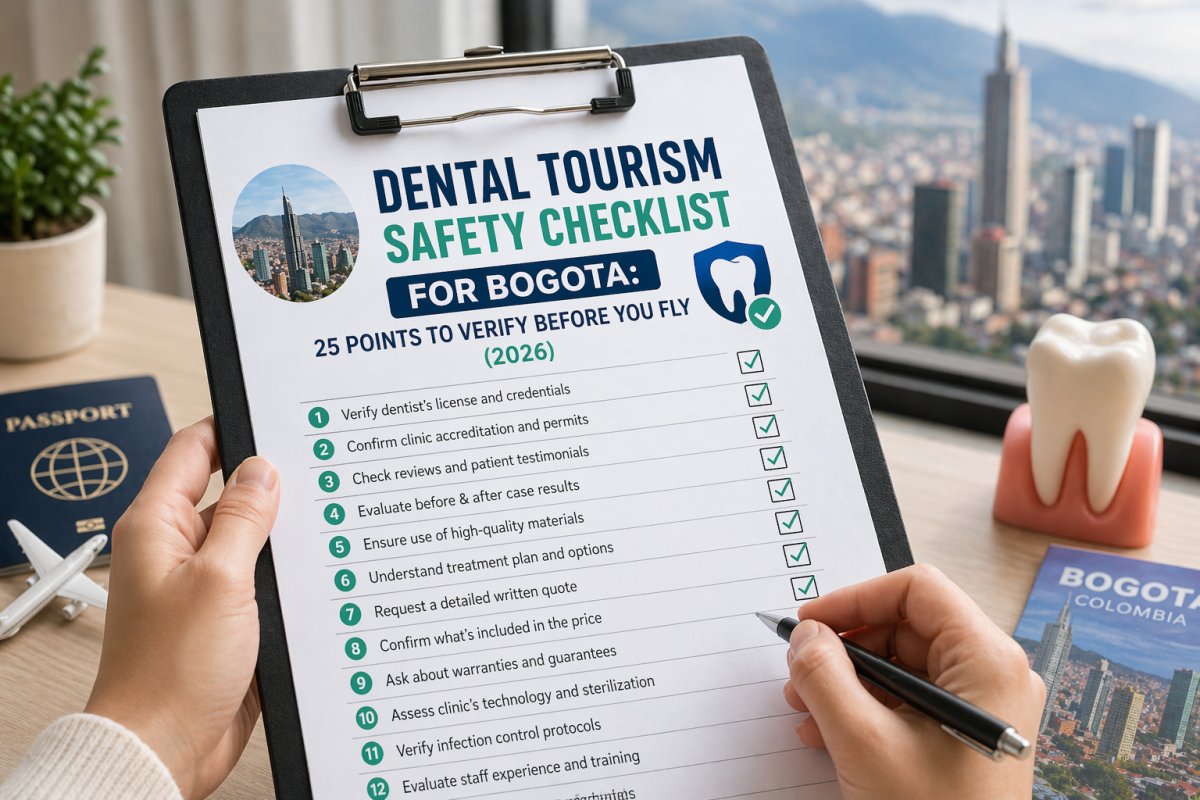
Dental tourism is safer than its reputation suggests -- when you verify the right things. Colombia has regulated dental practice under INVIMA (the national medical device authority), Bogota's northern districts concentrate internationally trained specialists, and the price savings you see come from lower cost of living, not lower clinical standards. The patients who return home happy are not luckier. They are better prepared.
Safety in dental tourism is patient-driven. What you verify before booking determines outcomes far more than the destination you pick. A Bogota clinic that cannot or will not answer pointed questions about credentials, materials, sedation, and records is not the right clinic -- and that filter is something you can apply in 30 minutes from your kitchen table, long before you book a flight.
This 25-point checklist walks through every verification step across five categories: clinic credentials, treatment plan, clinical safety, financial safety, and travel safety. Print it or save the page, work through each item in order, and only commit to travel when every point is answered in writing.
How To Use This Checklist
Print this page or save it to your phone. Work through every section before you book flights or pay any deposit. Each of the 25 points is a concrete verification step -- not a general principle. A clinic that cannot produce a clear written answer to any of these questions is not the clinic for an international patient flying in for complex work.
Reputable Bogota clinics expect these questions from informed international patients. Dr. Cristina Suaza's team at Dentica, the emergency-focused team at Clinica Estetica Dental 24 Horas, and the other leading practices in the northern districts have written materials ready for every point on this list. Silence, vague non-answers, or pressure to pay a deposit before questions are answered are all reasons to move on.
Allow yourself two weeks between first contact and booking flights. The better the clinic, the more documentation they will send unprompted -- and the more room you have to compare, consult your home dentist, and confirm everything fits before you commit.
Section A: Clinic Credentials (5 points)
Before you look at prices, confirm you are speaking to a qualified team at a real clinic. These five points cover professional registration, depth of experience, materials regulation, and independent review signal.
Point 1 -- Clinician identity and qualification
What to verify: Who will actually perform the treatment? What is their specialty qualification -- general dentist, oral surgeon, periodontist, or prosthodontist?
How: Ask for the treating doctor's name and tarjeta profesional (Colombian professional registration) number. Cross-reference the name and qualification on the clinic's website and on public registries. Top Bogota clinics publicise surgeon CVs, including specialty training and years of practice, as a matter of course.
Point 2 -- Years of experience in your specific procedure
What to verify: Single implants placed per year, veneer cases completed, All-on-4 arches delivered. Volume in your specific procedure, not general dentistry.
How: Ask: "How many single implants do you place per year? How many All-on-4 arches have you delivered in the past 3 years?" A clinic comfortable with the numbers will answer directly with figures. A clinic that deflects to general marketing language is raising a flag you should not ignore.
Point 3 -- Specialist placement for surgical cases
What to verify: Implants should be placed by oral surgeons, periodontists, or prosthodontists with documented implant training -- not by general dentists.
How: Ask directly: "Who places the implants -- a general dentist or a specialist?" Top Bogota clinics such as Dentica by Cristina Suaza publicise their surgeon-led approach and will name the treating specialist in writing before you pay any deposit.
Point 4 -- INVIMA-registered materials
What to verify: All implants, bone grafting materials, membranes, and prosthetic components must be INVIMA-approved. INVIMA (Instituto Nacional de Vigilancia de Medicamentos y Alimentos) is Colombia's equivalent of the US FDA.
How: Request written confirmation that materials carry INVIMA registration. Ask for the registration numbers of the implant system and the bone graft material. Reputable clinics provide these without friction.
Point 5 -- Google Reviews and independent patient feedback
What to verify: 4.5+ stars with 100+ reviews. Read both 5-star and 1-2 star reviews. Look for patterns in the negative reviews -- occasional complaints are normal; consistent themes are a warning.
How: Google Maps search. Ignore review-mill clinics with suspiciously uniform 5-star reviews from unverified accounts all posted in the same week. Dentica by Cristina Suaza (203 reviews, 5.0 average) and Clinica Estetica Dental 24 Horas (127 reviews, 4.6 average) are examples of sustained, long-dated review histories.
Section B: Treatment Plan (5 points)
A treatment plan is a contract in all but name. Every component must be itemised, every material named, and every visit scheduled -- in writing, before you board a plane.
Point 6 -- Written itemised treatment plan
What to verify: Each component priced separately -- implant fixture, abutment, crown, bone graft if needed, sinus lift if needed, sedation if needed, CBCT imaging.
How: Request a PDF quote before paying any deposit. A single lump-sum with no breakdown is a red flag. A proper quote shows unit prices, material brands, quantities, and a subtotal for each phase of treatment.
Point 7 -- Implant brand named in writing
What to verify: Nobel Biocare, Straumann, Osstem, Neodent, or another named brand with lot numbers available on request.
How: Ask: "What implant brand will you use, and will I receive the batch/lot certificate?" Refuse any "premium-quality implant" non-answer. The implant brand is the single strongest predictor of long-term clinical outcome and warranty coverage.
Point 8 -- Crown material specified
What to verify: Zirconia, monolithic zirconia, layered zirconia, e.max lithium disilicate, or PFM -- specified in writing on the quote.
How: Confirm material on the written quote. Generic "porcelain crown" is insufficient. If the crown will be milled at an in-house lab, confirm the CAD/CAM system and the ceramic block manufacturer.
Point 9 -- Number of visits and timeline
What to verify: For standard implants, typically 2 visits (surgical placement + permanent crown 3-6 months later after osseointegration). For All-on-4, 2 visits unless a same-day provisional protocol applies. For veneers, a single visit of at least 7 working days to allow proper lab time.
How: Written itinerary provided before booking flights. Each visit should show arrival day, appointment days, and departure day with a buffer between final check and flight home.
Point 10 -- Second opinion at home
What to verify: Your home dentist reviews the Bogota plan and confirms clinical reasonableness -- procedure, sequence, and materials all look appropriate for your case.
How: Share the treatment plan and X-rays with your home dentist. Most home dentists will review a colleague's proposed plan for a modest fee. Reputable Bogota clinics expect this step and provide the files proactively.
Section C: Clinical Safety (5 points)
Five non-negotiables for the clinical side of treatment -- imaging, sterilisation, sedation, records, and emergency cover. These are the points where good clinics distance themselves from average ones.
Point 11 -- CBCT 3D scanning for implants
What to verify: Cone Beam CT scan for implant placement planning -- not just a 2D panoramic.
How: Confirm CBCT is included in the surgical protocol and that the scan will be taken and reviewed before any implant is placed. Skipping CBCT for implants is below the modern standard of care; insist on it regardless of price.
Point 12 -- Sterilisation and instrument handling
What to verify: Autoclave sterilisation for all reusable instruments, single-use disposables where applicable (needles, scalpels, suction tips).
How: Most clinics welcome a pre-treatment tour of the sterilisation area. Ask to see it during your first consultation. A confident, open answer is the right answer.
Point 13 -- Sedation protocols (if applicable)
What to verify: IV sedation administered by a licensed anaesthesiologist, not by the dentist. General anaesthesia only in hospital settings.
How: Ask for the anaesthesiologist's name, credentials, and professional registration if IV sedation is planned. Dentica by Cristina Suaza, for example, uses a dedicated licensed anaesthesiologist for IV sedation cases.
Point 14 -- Digital records and X-ray transfer
What to verify: All X-rays (CBCT, panoramic, intra-oral) provided to you digitally before departure -- not just printed photos of the screen.
How: Confirm before booking that you will receive DICOM files on USB or via secure email. Your home dentist needs these files for continuity of care. If the Bogota clinic refuses to release your own records, that is disqualifying.
Point 15 -- Emergency coverage during stay
What to verify: After-hours contact number or 24/7 emergency line for in-trip issues.
How: Ask: "What do I do if I have severe pain or bleeding at 11pm on a Saturday?" Reputable clinics have a protocol and a named on-call contact. Clinica Estetica Dental 24 Horas runs 24/7 coverage as the core of its service model, and other top practices have after-hours WhatsApp lines for active patients.
Section D: Financial Safety (5 points)
Money handling is where a small share of dental tourism trips go wrong -- almost always because the patient did not agree terms up front. Lock these five points down before your card is charged.
Point 16 -- Deposit protection
What to verify: Deposits refundable with reasonable notice (typically 7-14 days). Deposit receipt provided.
How: Get written cancellation terms before paying any deposit. The clinic should be willing to tell you exactly how much is refundable and by when, in writing, without friction.
Point 17 -- Payment methods and currency
What to verify: Clinic accepts Visa and Mastercard. Card surcharge disclosed in advance (typically 3-4% in Colombia). Quote currency clarified (USD or COP).
How: Ask before travel. Card payment is strongly preferred over cash -- it gives you chargeback protection and a paper trail. Large cash USD payments carry more risk and fewer options if something goes wrong.
Point 18 -- Clinic warranty terms in writing
What to verify: The clinic itself provides a written warranty on implants -- typically 5-10 years on the fixture and 1-2 years on the crown component. The warranty document is issued by the clinic, signed by the clinic director.
How: Request the clinic's own warranty document before treatment. Read the exclusions carefully (smoking, missed check-ups, and untreated gum disease are common exclusions). SmileJet does not provide any warranty -- the clinical warranty is entirely between you and the treating clinic, so the clinic's own document is what matters.
Point 19 -- Remediation policy
What to verify: If a complication occurs that is covered by the clinic's warranty, what does the clinic actually cover? Return travel costs are rarely covered; redo treatment typically is.
How: Written policy from the clinic, usually included as part of the warranty document. Ask pointed questions about who pays for what -- lab fees, local hotel nights for a follow-up visit, and any consumables needed for the redo.
Point 20 -- Travel insurance with dental coverage
What to verify: Your travel policy covers emergency dental treatment (not elective) at minimum. Providers such as World Nomads, SafetyWing, and IMG Global offer dental emergency coverage. Most standard travel policies do not cover planned procedures abroad.
How: Read your travel insurance certificate carefully. Pay attention to exclusions for "tourism for medical purpose" and confirm what happens if an unrelated dental emergency occurs while you are in Bogota for planned treatment.
Section E: Travel Safety (5 points)
The travel side of the trip has its own checklist. Bogota is safe for international patients who stay in the right districts and follow basic precautions; the five points below cover where to sleep, how to move, and what to carry.
Point 21 -- Accommodation in northern Bogota only
What to verify: Stay in Chapinero, Usaquén, Chicó Norte, or Santa Bárbara.
How: These are the northern districts where international dental clinics cluster and where the tourist safety profile is strongest. Hotels, serviced apartments, and Airbnbs in these zones keep you close to your clinic, to safe restaurants, and to reliable ride-share pickup points.
Point 22 -- Airport ground transport planned in advance
What to verify: Uber or official El Dorado taxi counter only. Do not accept unsolicited "taxi" offers at arrivals.
How: Download Uber before travel and set up a payment method. Know where the official taxi counter is inside the arrivals hall -- it is clearly signposted. Many clinics will arrange an airport pickup for major cases; confirm this in writing before departure.
Point 23 -- Medication continuity
What to verify: Blood thinners, bisphosphonates, diabetes medication, antidepressants -- disclose all current medications and recent infusions to your Bogota clinic before travel.
How: Medical history form completed in advance. Bring a 1 week buffer supply of all prescription medications. Some medications (IV bisphosphonates, certain immunosuppressants) can affect implant healing and must be discussed with the treating surgeon well before the surgical day.
Point 24 -- Altitude preparation
What to verify: Bogota sits at 2,600 metres. Plan a rest day on arrival before any clinic appointment. Avoid alcohol in the first 48 hours. Drink extra water.
How: Build the rest day into your itinerary. Do not schedule treatment on arrival day. Patients arriving from sea level often experience mild headache, fatigue, and shortness of breath for the first 24-48 hours; surgery on day one compounds that unnecessarily.
Point 25 -- Emergency contacts and health records
What to verify: Travel insurance emergency line, your home dentist contact, a family emergency contact -- all in printed form and on your phone. Carry a copy of your passport, visa stamp, and treatment plan.
How: Paper copy in your wallet. Digital copies in your email and phone. Add the clinic's emergency number to your phone contacts on day one. If you have any chronic medical condition, carry a brief summary in Spanish as well as English.
How Patients Get Into Trouble
Most dental tourism trips to Bogota go well. The small share that go wrong almost always share the same failure modes. This section is not about blaming patients -- it is about naming the patterns early so you can avoid them.
- Booking on price alone. USD 400 implants from unbranded suppliers do fail at higher rates than name-brand implants placed by specialists. Savings of 60-70% over US prices are real and sustainable with Nobel Biocare or Straumann; savings of 90% usually mean something has been cut that should not have been.
- Skipping the second opinion at home. Overtreatment happens when only one dentist reviews a complex plan. A home dentist who is not selling you the work is a valuable sanity check on whether every tooth on the plan really needs the proposed intervention.
- Rushing the timeline. 3-day veneer trips produce rushed lab work and preparation decisions made under time pressure. Insist on 7 days minimum for any veneer case and 10-14 days for full-arch work including try-ins.
- Paying cash without receipts. Always get itemised receipts and confirm your card charges match the quote line for line. Cash transactions without proper documentation leave you with no chargeback recourse and no evidence for a warranty claim.
- Ignoring red flags during consultation. If the clinic cannot answer your questions, the clinic is not the one. Pressure to commit on the first call, vague answers about implant brands, reluctance to share X-rays, or inconsistent stories between the front desk and the treating dentist are all reasons to walk away -- before money changes hands.
Frequently Asked Questions
Is dental treatment in Bogota safe?
Yes, at properly vetted clinics. Colombia's INVIMA regulates dental materials, Bogota's leading clinics use Nobel Biocare and Straumann implants, and oral surgeons at top practices such as Dentica by Cristina Suaza have 20+ years of specialist experience. Safety is determined by clinic selection, not country selection. The 25-point checklist in this guide is how informed patients choose safely.
What is INVIMA and why does it matter?
INVIMA (Instituto Nacional de Vigilancia de Medicamentos y Alimentos) is Colombia's national medical device regulator, equivalent to the US FDA. INVIMA certifies dental implants, bone grafting materials, and prosthetic components as safe for use in Colombia. Always confirm that your chosen clinic uses INVIMA-registered materials, and request the certificate numbers in writing before treatment starts.
What does SmileJet guarantee?
SmileJet is a marketplace that connects international patients with vetted clinics. SmileJet does not provide clinical services and does not issue warranties. Any clinical warranty is provided directly by the treating clinic -- typically 5-10 years on implant fixtures and 1-2 years on crown components. Always request the clinic's own written warranty before treatment.
Should I get a second opinion at home before travelling to Bogota?
Yes. Share your Bogota treatment plan and X-rays with your home dentist. This is a clinical safety step, not a sign of distrust in the Bogota clinic. Reputable Bogota practices expect patients to do this and welcome the additional scrutiny. If your home dentist flags clinical concerns, raise them with the Bogota clinic before paying any deposit.
What happens if a complication occurs after I return home?
First, contact the Bogota clinic directly via their WhatsApp or email support line -- most reputable clinics respond within 24 hours. Second, see your home dentist for immediate clinical assessment using the records you collected before departure. Third, invoke the clinic's written warranty for any covered remediation. SmileJet's support team can help coordinate communication with the clinic if needed, but the clinical warranty itself is between you and the clinic.
Related Articles
- The Complete 2026 Guide to Dental Tourism in Bogota -- overview of costs, clinics, and treatment options for international patients.
- How to Plan a Dental Trip to Bogota in 2026 -- step-by-step planning from first enquiry to flying home.
- Where to Stay in Bogota for Dental Treatment (2026) -- neighbourhood-by-neighbourhood accommodation guide for dental patients.
- Dental Implants in Bogota 2026: Pricing, Brands and Timelines -- implant-specific cost and procedure guide.
- Bogota Dental Tourism FAQ 2026 -- detailed answers to the most common patient questions.
- Bogota Dental Tourism for US Patients (2026) -- guide tailored to American patients travelling from the United States.
This content is for informational purposes only and does not constitute medical advice. Consult a qualified dental professional before undergoing any dental procedure. Treatment outcomes vary by individual. SmileJet facilitates connections between patients and clinics and does not provide dental treatment directly. Any clinical warranty is provided by the treating clinic, not by SmileJet.
Prices are indicative; only a clinic's written quote applies to you. See how we source prices. SmileJet is an information service, not a healthcare provider, and nothing here is medical advice.
Want this priced for your own mouth? Send a photo and we will come back with written quotes from clinics that fit.
Get my quoteKeep reading
Related guides.
Questions to ask a Cuenca dentist before you book
Twelve questions that separate a quote you can rely on from one you cannot. Ask them before you book flights.
Why Ecuador quotes dental work in US dollars
Ecuador is the rare dental destination where the quoted number and the paid number are the same.
Ecuador, Costa Rica or Mexico for dental work
An honest comparison, including the ways Ecuador loses. We list one clinic there, and that is a real limitation.
Send a photo. Get three quotes.
It costs nothing and it does not commit you to anything. Most people hear back the same day.