All-on-4 Dental Implants in Krakow: Full Arch Restoration for International Patients (2026)
Poland's highest-volume All-on-4 surgeon. 900+ cases personally. Nobel Biocare Platinum Excellence Center. EUR 6,500 per arch.
- All-on-4 from EUR 6,500/arch (acrylic) to EUR 13,500/arch (monolithic zirconia)
- Dr. Trzepatowski: 198 All-on-4 cases in 2024 alone, highest volume in Poland
- Poland's only Malo Clinic certified All-on-4 trainer
- Nobel Biocare Platinum Excellence Center (2024)
- Same-day fixed provisional teeth. Fly home on Day 7 with a full arch.
- All-on-4 is the most-searched dental tourism procedure from the UK, Ireland, Norway, and the Netherlands.
- Krakow offers All-on-4 at 30-40% of UK/Irish prices, with no quality compromise at specialist volume centres.
- HALDENT Dental Clinic in Zabierzow (10 minutes from KRK airport) is the undisputed volume leader in Poland.
- Two visits required: Visit 1 (5-7 days) for surgery and provisional. Visit 2 (3-5 days, 4-6 months later) for final prosthesis.
- Monolithic zirconia costs more upfront but lasts 15-20+ years versus 3-7 years for acrylic hybrid.
What Is All-on-4 and Why Are Patients Travelling to Krakow for It?
All-on-4 is consistently the most-searched dental tourism procedure among patients aged 50-70 from the UK, Ireland, Norway, Sweden, the Netherlands, and Australia. The reason is straightforward: a full-arch fixed restoration in the UK costs GBP 22,000 per arch. The same procedure with a Nobel Biocare implant system, performed by a surgeon with 900+ personal cases, costs EUR 6,500-13,500 in Krakow depending on bridge material. For two arches, the saving typically exceeds EUR 25,000 even after flights and accommodation.
Krakow is not a generic dental tourism city. It has one clinic that has become the dominant All-on-4 centre in Poland by pure case volume: HALDENT Dental Clinic in Zabierzow, a 10-minute drive from Krakow airport. HALDENT's lead surgeon, Dr. Hubert Trzepatowski, performed 198 All-on-4 cases in 2024 alone, the highest annual volume of any surgeon in Poland. He has performed over 900 All-on-4 cases personally. He is the only Malo Clinic certified All-on-4 trainer in Poland, certified directly by MALO CLINIC Lisbon, the clinic that developed the procedure. He has been a Nobel Biocare Key Expert since 2019, and in 2024 HALDENT was designated a Nobel Biocare Platinum Excellence Center.
These are not marketing claims. They are verifiable accreditations with specific thresholds. Platinum Excellence designation from Nobel Biocare requires sustained volume and clinical outcomes across multiple years. Malo Clinic trainer certification requires direct assessment by the MALO CLINIC Portugal team. Both matter because All-on-4 outcomes correlate directly with surgeon case volume. This is documented in implant literature. A surgeon at 30 cases per year and a surgeon at 198 cases per year operate in fundamentally different clinical brackets.
The All-on-4 Procedure: How It Works
All-on-4 was developed by Professor Paulo Malo at MALO CLINIC in Lisbon, Portugal, in the early 2000s. The core innovation is geometric: by tilting the two posterior implants at up to 45 degrees, surgeons achieve better bone engagement without the need for bone grafting in most cases, and distribute the load of a full-arch bridge across four anchor points instead of the six to eight used in traditional full-arch implant protocols.
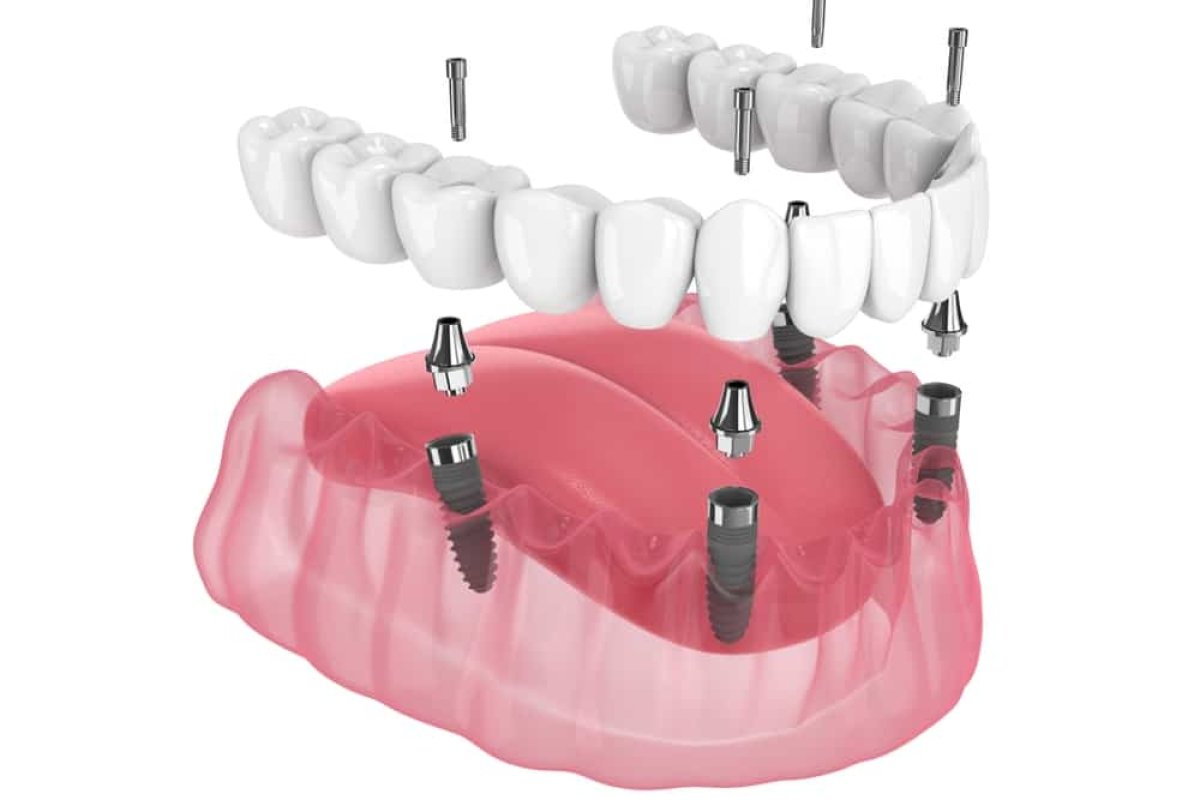
The four titanium implants are placed in the jaw during a single surgical session. The two anterior implants are placed vertically. The two posterior implants are angled. Together, they form a rectangle of support that spans the arch. A fixed bridge of 10-14 teeth is attached to four abutments above the gumline. No individual sockets per tooth. No removable denture. A single rigid prosthesis screwed or cemented to the implants.
The immediate-loading protocol, which HALDENT follows, means the provisional fixed prosthesis is fitted on the same day as surgery. Patients undergo surgery in the morning and leave the clinic in the afternoon or evening with a full arch of fixed provisional teeth. Those provisional teeth remain in place for 4-6 months while the implants undergo osseointegration, the biological process by which titanium fuses with living bone. Once osseointegration is confirmed by CBCT scan, patients return for the second visit and have the final permanent prosthesis fitted.
This same-day protocol distinguishes All-on-4 from traditional implant procedures that require 3-6 months of healing before any prosthesis is attached. With All-on-4, patients do not spend months without teeth. They fly home with a fixed arch and resume normal social and professional life, adapting to a soft-food diet during the osseointegration period.
All-on-4 vs All-on-6 vs All-on-X: Which Protocol Is Right for You?
The All-on-4 label is widely used but not always applied consistently. Some clinics use it to describe any fixed full-arch implant protocol. The table below clarifies the three main protocols and what each is suited for.
| Protocol | Implants | Best For | Per Arch (Krakow) |
|---|---|---|---|
| All-on-4 | 4 | Standard bone volume; lower jaw is the most common application | EUR 6,500-13,500 |
| All-on-6 | 6 | Upper jaw; low bone density; bruxism (teeth grinding) | EUR 8,500-16,000 |
| All-on-X | 4-8 | Complex anatomy; severe bone deficiency; fully customised plan | EUR 9,000-18,000 |
HALDENT performs all three protocols. The appropriate protocol for each patient is determined by CBCT scan analysis at the consultation on Day 2 of Visit 1. The scan maps bone density, height, and width across the jaw, allowing Dr. Trzepatowski to select implant diameter, length, angle, and positioning for each individual anatomy. There is no one-size approach. A patient arriving expecting All-on-4 may be recommended All-on-6 if the upper jaw scan reveals insufficient bone density for the posterior angle implants, or may be confirmed as an excellent All-on-4 candidate if bone volume is adequate.
Bridge Material Comparison: The Most Important Patient Decision
The prosthesis material is the single most important financial and clinical decision in the All-on-4 process. Patients frequently focus on the implant brand (Nobel Biocare, Straumann) and underestimate the bridge decision. The implants are expected to last decades if well-integrated. The bridge, depending on material, may not.
| Material | Per Arch (Krakow) | Lifespan | Notes |
|---|---|---|---|
| Acrylic hybrid | EUR 6,500-8,500 | 3-7 years | Entry tier. Lighter, lower cost. Wears and may discolour over time. Standard warranty 12-24 months. |
| Titanium bar + composite | EUR 8,500-10,500 | 7-12 years | Mid tier. Titanium frame provides rigidity; bonded composite teeth. Better fracture resistance than acrylic alone. |
| Monolithic zirconia | EUR 10,500-13,500 | 15-20+ years | Premium tier. Single milled block. No bonded teeth to chip or detach. Highly biocompatible. Recommended if budget allows. |
Monolithic zirconia is milled from a single block of ceramic in HALDENT's in-house lab. Because it is a single piece, there are no bonded elements to chip or detach, which is the most common prosthesis complication with acrylic and composite tier bridges. Zirconia is also highly biocompatible, and its hardness resists wear from normal chewing forces over years. The provisional prosthesis fitted on surgery day is always acrylic regardless of which final material tier you select, because zirconia cannot be produced same-day and the provisional must allow for minor positional adjustments during osseointegration.
See the full dental implants Krakow guide for further explanation of implant and prosthesis material science.
All-on-4 Cost Comparison: Krakow vs UK, Ireland, Germany, Norway, USA
The table below compares standard published pricing for All-on-4 per arch with an acrylic hybrid prosthesis across key source markets for dental tourists travelling to Krakow. These are representative figures, not quotes. Prices vary by clinic and patient complexity.
| Country / City | Typical Cost (All-on-4, acrylic, per arch) | vs Krakow |
|---|---|---|
| UK | GBP 22,000 | 3.4x more expensive |
| Ireland | EUR 26,000 | 3.5x more expensive |
| Germany | EUR 20,000 | 2.7x more expensive |
| Norway | NOK 280,000 (~EUR 24,000) | 3.2x more expensive |
| Netherlands | EUR 22,000 | 2.9x more expensive |
| USA | USD 28,000 | 3.6x more expensive |
| Krakow (acrylic hybrid) | EUR 6,500-8,500 | Baseline |
| Krakow (monolithic zirconia) | EUR 10,500-13,500 | Baseline |
A UK patient choosing zirconia All-on-4 at HALDENT (EUR 13,500 per arch, both arches = EUR 27,000) typically saves over EUR 17,000 compared to having the same procedure in the UK with an acrylic bridge. Savings are larger still if UK pricing for zirconia is used as the comparison. Return flights from any major UK airport to Krakow are typically GBP 60-150 per person return. The financial case is unambiguous.
Patients from Australia or Asia often combine a Krakow trip with broader European travel, given that the two-visit structure already requires two separate journeys. See the Krakow dental tourism guide for Australian patients for routing and planning details.
Am I a Candidate for All-on-4? Candidacy and Contraindications
Most adults with failing or missing teeth are suitable candidates for All-on-4 if general health conditions are stable. Candidacy is confirmed by full CBCT scan analysis, which HALDENT conducts during the first consultation. The following factors are assessed.
Factors Supporting Candidacy
- Sufficient bone volume in the jaw (measured in Hounsfield units on CBCT)
- Controlled systemic health: blood pressure, blood glucose, thyroid function
- Non-smoking or willing to quit 4-6 weeks before surgery and during osseointegration
- Realistic expectations about provisional prosthesis diet restrictions (soft food for 4-6 months)
- Commitment to both visits and long-term maintenance hygiene
Contraindications and Complicating Factors
- Uncontrolled diabetes: High HbA1c impairs osseointegration and wound healing. Surgery is postponed until glucose control is stable.
- Active cancer treatment: Radiotherapy and certain chemotherapy agents compromise bone healing. Surgery is not performed during active treatment.
- Bisphosphonate or anti-resorptive medication: Patients on long-term bisphosphonates (for osteoporosis) carry elevated risk of osteonecrosis of the jaw. Full medication review required.
- Severe bone loss (atrophic jaw): Patients with very little residual bone may require zygomatic implants (anchored in the cheekbone) rather than standard All-on-4. HALDENT can assess and refer for zygomatic cases.
- Active smoking during osseointegration: Smoking during the 4-6 month healing phase significantly increases implant failure risk. HALDENT requires cessation as a condition of treatment.
- Severe bruxism (uncontrolled teeth grinding): May require All-on-6 rather than All-on-4, and a night guard with the final prosthesis.
Patients with controlled systemic conditions, a history of gum disease now resolved, or moderate bone loss should not self-exclude. CBCT at HALDENT will determine candidacy accurately. Pre-travel CBCT images from a local radiologist can be emailed to HALDENT for a preliminary remote assessment before booking flights.
The Two-Visit Protocol: Day-by-Day at HALDENT
Understanding the two-visit structure is essential for trip planning. The full process is described below as it operates at HALDENT Dental Clinic in Krakow.
Visit 1: Surgery and Provisional Prosthesis (5-7 Days)
Day 1: Arrive in Krakow. HALDENT offers free airport pickup from KRK (Krakow John Paul II International Airport). On-campus accommodation room available for patients who prefer to stay close to the clinic. Check in, rest, orientation.
Day 2: Full consultation with Dr. Trzepatowski. CBCT scan taken on-site. Scan analysis and final treatment plan presented to patient. Any remaining questions answered. Surgical consent signed. Pre-operative instructions given (fasting window, medications).
Day 3: Surgery Day. Sedation offered (IV sedation or local anaesthetic based on patient preference and suitability). Remaining teeth extracted where indicated. Four Nobel Biocare titanium implants placed in pre-planned positions. Provisional fixed prosthesis fabricated and fitted the same day. Patient leaves the clinic in the evening with a full arch of fixed provisional teeth.
Days 4-5: Recovery. Soft food diet. Swelling is normal and typically peaks at 48-72 hours. HALDENT review appointment to check prosthesis seating, occlusion, and patient comfort. Minor adjustments made if needed.
Day 6: Final pre-departure check. Suture inspection. Written aftercare instructions, emergency contact, and follow-up plan issued.
Day 7: Fly home. Patient departs with a functional fixed arch. Provisional prosthesis is designed to be worn during the osseointegration period. Soft food diet continues at home for the full 4-6 months.
Visit 2: Permanent Prosthesis (3-5 Days, 4-6 Months Later)
Day 1: Arrive in Krakow. Review appointment. CBCT scan confirms osseointegration. Provisional prosthesis removed. Impressions taken for final prosthesis. (For zirconia cases, digital scans taken instead.)
Days 2-3: Final prosthesis milled and fabricated in HALDENT's in-house lab. Zirconia cases require a try-in appointment: prosthesis is temporarily seated for patient assessment of aesthetics and bite before final cementation. Adjustments made same-day if needed.
Day 4: Final prosthesis permanently fitted. Occlusion adjusted and verified. Hygiene instruction for the permanent prosthesis. Lifetime implant warranty documentation issued directly to patient.
Day 5 (if needed): Final review before departure. Patient flies home with permanent full-arch restoration.
Patients travelling from the UK should note that direct flights from London Gatwick, Manchester, and Edinburgh to Krakow KRK operate year-round with Ryanair, Wizz Air, and easyJet. Flight time is approximately 2.5-3 hours from most UK departure points. See the UK patient travel guide to Krakow for full logistics including accommodation options near HALDENT.
Aftercare and Long-Term Hygiene
All-on-4 is a fixed prosthesis, not a removable denture. It does not come out for cleaning. This is the primary advantage over traditional dentures, but it creates a hygiene requirement that patients must commit to for life. Failure to maintain adequate hygiene around implant abutments leads to peri-implantitis, an infection of the tissue surrounding the implant that is the most common cause of late implant failure.
Essential Hygiene Tools
- Water flosser (oral irrigator): This is not optional. A water flosser directs a pressurised stream of water under the prosthesis bridge to flush debris from the gap between the bridge and the gum. Standard string floss cannot access this zone. Oral-B or Waterpik models are suitable. Use at least once daily.
- Interdental brushes: Used to clean around abutments. HALDENT will advise on the correct size at the final fitting appointment.
- Soft toothbrush: Electric or manual. Brush twice daily along the gumline and the biting surface of the bridge.
- Alcohol-free antibacterial mouthwash: Reduces bacterial load around abutments. Use once daily.
Dietary Guidance During Osseointegration (4-6 Months)
- Soft foods only: fish, eggs, pasta, soft vegetables, yoghurt, porridge, soft cheese.
- Avoid: crunchy foods, hard raw vegetables, crusty bread, hard sweets, chewing ice.
- Avoid alcohol for the first 2 weeks post-surgery (impairs healing).
- No smoking throughout the osseointegration period.
Long-Term Annual Maintenance
- Annual professional clean at HALDENT or a local implant-experienced dentist.
- Radiographic review at HALDENT every 2-3 years to monitor bone levels around implants.
- Report any loosening, pain, or unusual sound when biting promptly. These symptoms indicate a prosthesis issue or early peri-implant inflammation, both of which are manageable if caught early.
Ready to get a quote for All-on-4 in Krakow?
Compare clinics, see reviews, and request a free consultation with HALDENT through SmileJet.
Explore Krakow Dental ClinicsHALDENT Dental Clinic: The Krakow All-on-4 Specialist
HALDENT is not a general dental clinic that also offers implants. All-on-4 is the flagship procedure the clinic was built around. Dr. Trzepatowski's personal case volume of 900+ procedures, with 198 cases completed in 2024 alone, places him among the highest-volume All-on-4 surgeons globally, not just in Poland. His Malo Clinic certification, the training qualification issued by the clinic that originated the procedure, means he has been assessed and verified by the creators of All-on-4 themselves.
HALDENT's in-house prosthetic lab is a significant operational advantage. At most dental clinics, the final bridge is sent to an external laboratory, adding 1-2 weeks of production time and introducing a dependency on third-party quality control. At HALDENT, the prosthesis is fabricated on-site by HALDENT technicians under the direct supervision of the treating surgeon. This means same-day adjustments are possible, and the time from impression to fitting is shorter. For international patients whose availability in Krakow is finite, in-house lab production materially shortens Visit 2.
The on-campus patient accommodation room is a feature unique to HALDENT in the Krakow market. Patients who prefer not to travel to a city hotel in the days immediately after surgery can recover within the clinic premises. Given that Day 3 (surgery day) typically leaves patients with swelling and discomfort, the option to walk to a recovery room rather than take a taxi is genuinely useful, not just a marketing feature.
Honest Note on Prosthesis Tiers: Total Cost of Ownership
Acrylic hybrid bridges are not inferior due to poor clinic quality or technique. Acrylic is a softer material that undergoes wear under the daily forces of chewing. This is a material property. At 3-7 years, acrylic prostheses typically show visible wear, staining, and in some cases fracture of individual teeth bonded to the framework. Replacement is a prosthetic procedure, not a surgical one: the implants themselves remain in the jaw. However, replacement of a full-arch acrylic prosthesis costs EUR 2,500-5,000 each time it is done.
Consider a 60-year-old patient who chooses an acrylic hybrid at EUR 7,500 per arch. Over 20 years, assuming replacement every 5 years:
- Initial cost: EUR 7,500
- Year 5 replacement: EUR 3,500
- Year 10 replacement: EUR 3,500
- Year 15 replacement: EUR 3,500
- 20-year total: EUR 18,000
A monolithic zirconia bridge at EUR 12,000 per arch, if it lasts 20 years (which current clinical evidence supports), costs EUR 12,000 over the same period with no replacements. The total cost of ownership for acrylic exceeds zirconia in most lifetime scenarios. This is not an argument to always choose zirconia, as budget constraints are real, but it is the honest financial picture that patients deserve before making the decision.
HALDENT presents both options at consultation with full cost and longevity data. The final choice is the patient's.
Frequently Asked Questions
Related Articles
- Dental Tourism in Krakow 2026: Complete Guide for International Patients
- Dental Implants in Krakow 2026: Costs, Clinics and What to Expect
- Krakow Dental Tourism for UK Patients: Flights, Costs and Clinic Guide (2026)
- Krakow Dental Tourism for Australian Patients: Full Planning Guide (2026)
- How to Plan a Dental Trip to Krakow: Step-by-Step Guide (2026)
- Krakow vs Bangkok for Dental Work: Which Destination Wins in 2026?
Start Your All-on-4 Journey in Krakow
Get a free consultation with HALDENT, the highest-volume All-on-4 clinic in Poland. Compare listed clinics, read 174 patient reviews, and request your free quote today.
Explore Krakow Dental Tourism →